

Medically reviewed by John Bitner, MD — Double Board-Certified Facial Plastic and Reconstructive Surgeon.
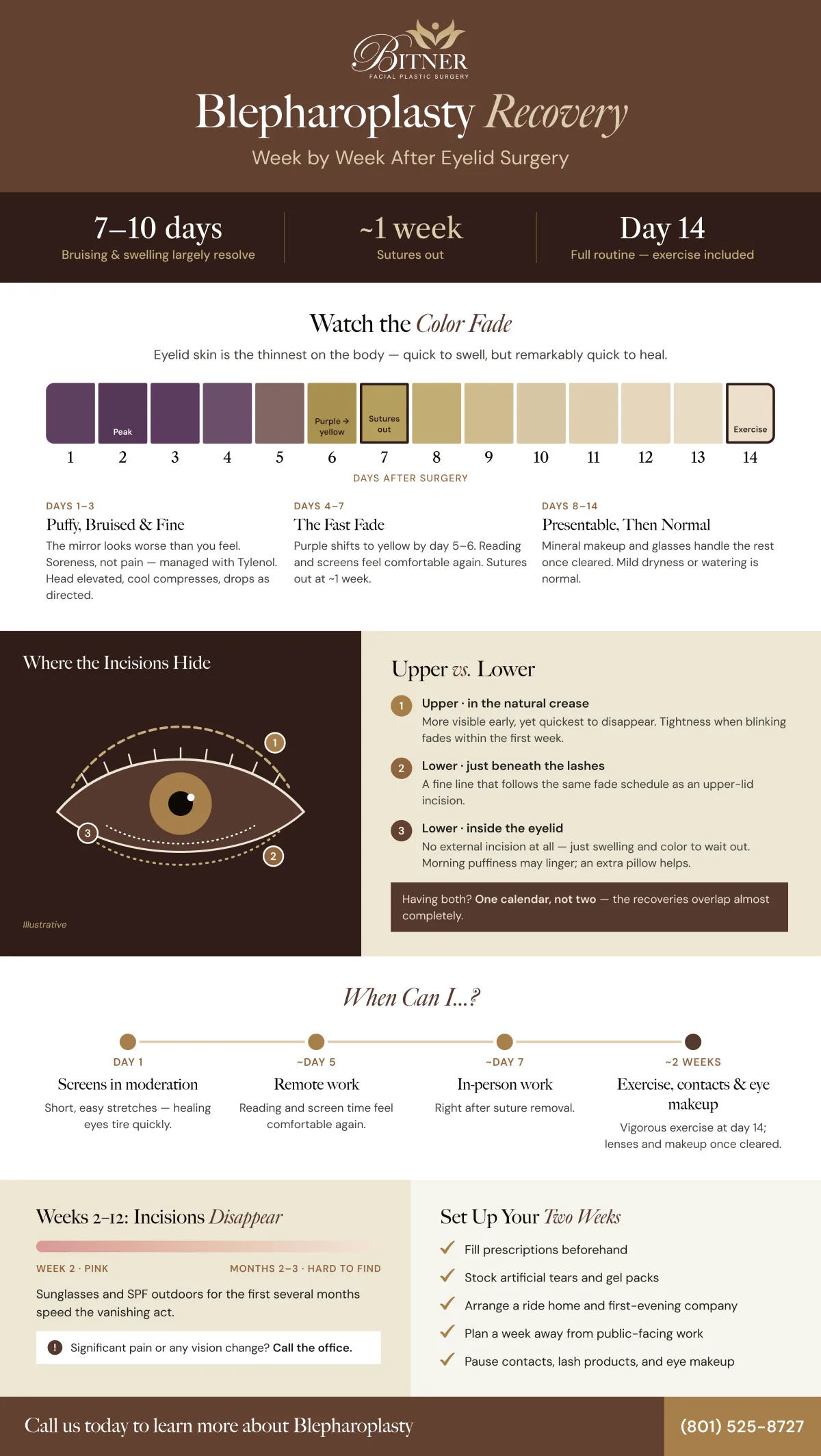
Blepharoplasty recovery is faster than almost any patient expects: bruising and swelling largely resolve within seven to ten days, sutures come out at about one week, and most people are back to their full routine — exercise included — by day fourteen. Eyelid skin is the thinnest on the body, which makes it quick to swell but remarkably quick to heal. Here’s the honest week-by-week picture for patients recovering from eyelid surgery in Utah with Dr. Bitner.
Days 1–3: Puffy, Bruised, and Fine
Expect the mirror to look worse than you feel. Swelling and bruising around the eyes peak in the first 48 to 72 hours and can be dramatic in appearance while causing surprisingly little discomfort — most patients describe soreness and tightness rather than pain, managed with Tylenol. The playbook is simple: head elevated at all times including sleep, cool compresses in gentle intervals, prescribed drops or ointment exactly as directed, and screens in moderation, since healing eyes tire quickly. Blurry vision from ointment and swelling is common and temporary. What warrants a call to the office — and Dr. Bitner’s team answers — is significant pain or vision change, which are uncommon but taken seriously.
Days 4–7: The Fast Fade
Eyelid bruising moves through its color sequence quickly. By day five or six, purple has usually shifted to yellow, swelling has visibly receded, and reading and screen time feel comfortable again. Short walks help circulation; bending, straining, and lifting still wait. Sutures are removed at approximately one week — a two-minute, anxiety-free appointment that most patients call the psychological finish line of early recovery. Many return to remote work around day five and in-person work right after suture removal.
Days 8–14: Presentable, Then Normal
In the second week, camouflage becomes trivial: once incisions have sealed and you’re cleared, mineral makeup covers residual discoloration, and glasses do the rest. Dry eyes, intermittent watering, or morning puffiness may linger — normal while lid function recalibrates — and lubricating drops keep things comfortable. Vigorous exercise resumes at day fourteen. From here, you’re done recovering in any practical sense; what remains is refinement.
Weeks 2–12: Incisions Disappear
Upper-lid incisions hide in the natural crease; lower-lid incisions sit inside the eyelid or just beneath the lashes. Through weeks two to six they fade from pink toward skin tone, and by two to three months they’re typically very difficult to find — a healing advantage unique to eyelid skin. Sun protection accelerates the vanishing act: sunglasses and SPF whenever you’re outdoors for the first several months. Contact lens wearers usually resume lenses at about two weeks with clearance.
Recovering From Upper, Lower, or Both
The timeline above holds whether you had upper lids, lower lids, or both treated together — combined cases heal on one calendar, not two. Lower blepharoplasty performed through the inside of the eyelid leaves no external incision at all, trimming the visible-recovery portion further. And when eyelid surgery is paired with a brow lift to treat the whole upper face, the recoveries run concurrently — one of the practical arguments for combined planning that Dr. Bitner reviews at consultation.
Set Up Your Two Weeks Well
The preparation list is short: fill prescriptions beforehand, stock artificial tears and gel packs, arrange a ride home and company for the first evening, plan a week away from public-facing work, and pause contact lenses, lash products, and eye makeup until cleared. Then let the timeline work. Two weeks after surgery, most patients look like themselves after a genuinely good vacation — which is the entire point. See the results this recovery buys in our blepharoplasty before-and-after gallery, and when you’re ready, call (801) 525-8727 to schedule a consultation in Layton. Your consultation fee is applied to the cost of your procedure.
Upper vs. Lower: Small Differences Worth Knowing
The combined timeline above fits both procedures, but each has its own personality. Upper blepharoplasty recovery is the more visible of the two early on — the incision sits in the crease you see when your eyes are open — yet it’s also the quicker to become invisible, since crease incisions hide themselves the moment healing color fades. Expect the tight-when-blinking sensation to be an upper-lid phenomenon, fading within the first week.
Lower blepharoplasty performed transconjunctivally — through the inside of the lid — has no external incision at all, so its recovery is essentially a swelling-and-bruising timeline with nothing to conceal but color. When a subciliary approach is used to also address skin, the fine line beneath the lashes follows the same fade schedule as an upper-lid incision. Lower-lid patients notice morning puffiness a bit longer, simply because fluid pools where gravity leaves it overnight; an extra pillow buys an easier mirror.
Patients having both together shouldn’t double their expectations — the recoveries overlap almost completely, which is precisely why combined treatment is so often the efficient choice.
Blepharoplasty Recovery FAQs
When can I wear contact lenses after eyelid surgery?
Typically around two weeks, once incisions have healed and Dr. Bitner clears you at follow-up. Lids can be slightly swollen and eyes drier than usual early on, so glasses are the comfortable default for the first stretch — and sunglasses outdoors are encouraged regardless.
How long will I use eye drops after blepharoplasty?
Prescribed drops or ointment usually run one to two weeks per your instructions, while over-the-counter lubricating drops can be used as long as comfort requires — often a few weeks, since temporary dryness is the most common lingering symptom while lid function normalizes.
When can I wear eye makeup again after blepharoplasty?
Generally around the two-week mark, after suture removal and clearance, once incisions are fully sealed. Start with fresh products to minimize irritation risk, and remove makeup gently — no scrubbing along healing incision lines for the first several weeks.
Sources: 1. Mayo Clinic — Blepharoplasty: https://www.mayoclinic.org/tests-procedures/blepharoplasty/about/pac-20385174 2. American Society of Plastic Surgeons — Eyelid Surgery: https://www.plasticsurgery.org/cosmetic-procedures/eyelid-surgery