

Medically reviewed by John Bitner, MD — Double Board-Certified Facial Plastic and Reconstructive Surgeon.
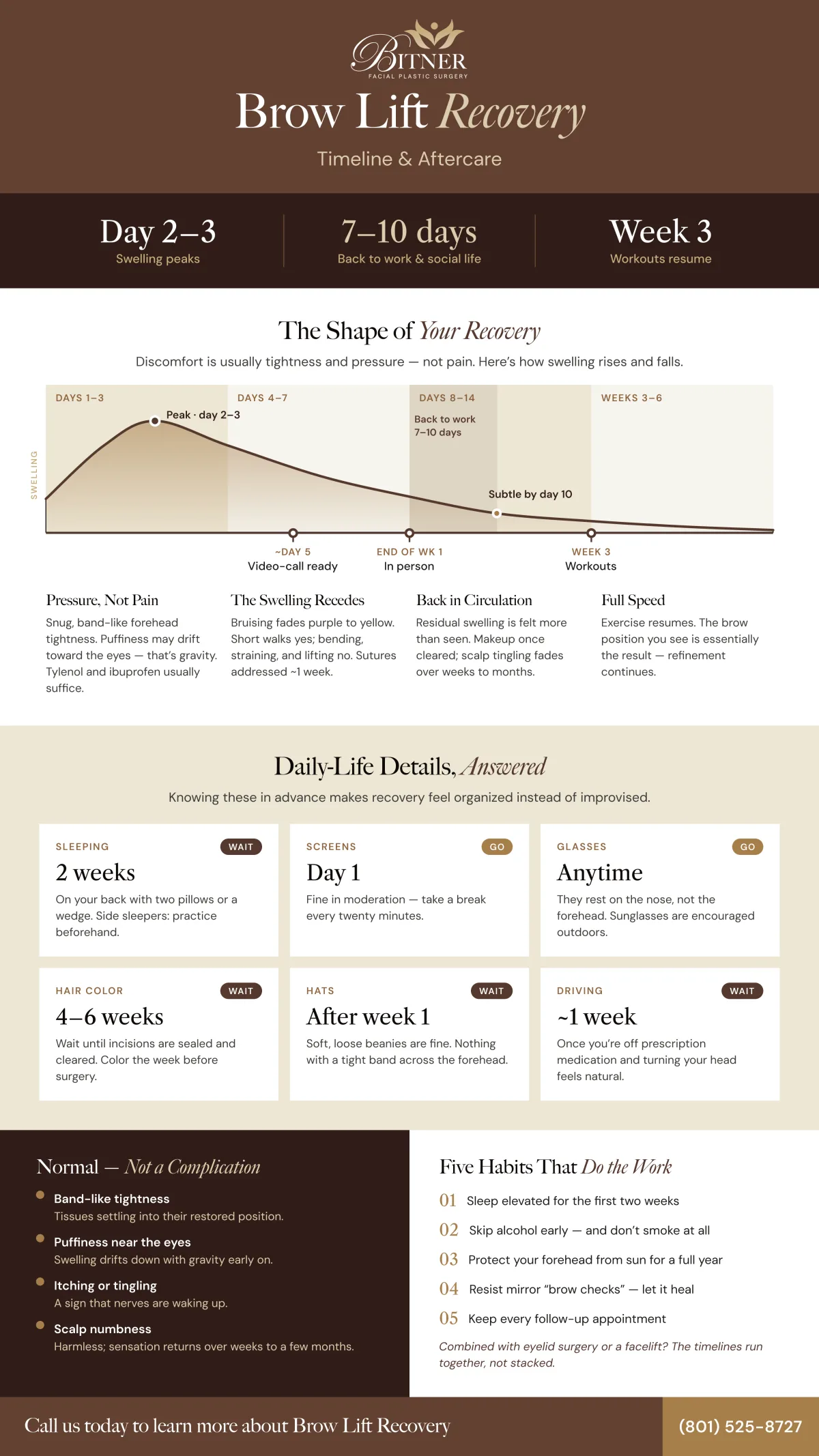
Brow lift recovery is one of the gentler timelines in facial surgery: swelling peaks within the first three days, most patients return to work in seven to ten days, and normal activity — workouts included — typically resumes by week three. The forehead heals predictably, incisions hide in or behind the hairline, and discomfort is usually described as tightness and pressure rather than pain. Here’s the week-by-week picture for patients recovering from a brow lift at Dr. Bitner’s Layton practice.
Days 1–3: Pressure, Not Pain
The first sensation most brow lift patients report is a snug, band-like tightness across the forehead — the treated tissues settling into their restored position. Swelling builds to a peak around day two or three and often drifts downward with gravity, so don’t be alarmed if puffiness or light bruising appears around the eyes even though the surgery was above them. Keep your head elevated, including while sleeping; use cool compresses in short intervals; and take it genuinely easy. Most patients manage comfortably with Tylenol and ibuprofen. Itching or tingling along the incision lines is a normal sign of nerves waking up.
Days 4–7: The Swelling Recedes
Mid-week, the timeline turns. Forehead swelling softens, any migrated bruising around the eyes begins fading through the familiar purple-to-yellow sequence, and energy returns. Short walks are encouraged; bending, straining, and lifting are not — anything that pushes blood pressure toward your head prolongs swelling. Depending on your incision plan, sutures or small fixation points are addressed at about the one-week visit. Many patients feel presentable on video calls by day five and in person by the end of the week.
Days 8–14: Back in Circulation
Most patients return to work and social life in the seven-to-ten-day window. Residual swelling is subtle by now — more something you feel than something others see — and makeup handles any lingering discoloration once you’re cleared. Numbness or tingling across the scalp behind the incisions is the most persistent sensation; it’s expected, harmless, and resolves gradually over weeks to a few months as sensory nerves recover. Hair washing resumes gently per your instructions, usually within the first several days.
Weeks 3–6: Full Speed, Finishing Touches
Exercise restrictions typically lift around week three. The brow position you see now is essentially the result, with fine refinement continuing as the last deep swelling clears. Incision lines within the hairline are concealed from day one; any visible segments fade from pink toward skin tone over the following months. If your brow lift was performed endoscopically — through a few small incisions hidden in the scalp — the finishing phase is often even quicker; our companion post on the endoscopic brow lift explains that technique in depth.
Aftercare That Actually Moves the Needle
Five habits do most of the work: sleep elevated for the first two weeks; skip alcohol during early healing and don’t smoke at all; protect your forehead and any visible incisions from sun for a full year; resist heavy brow movement checks in the mirror (the tissue is healing — let it); and keep every follow-up so small questions get answered while they’re still small. If your brow lift was combined with eyelid surgery or a facelift — a common pairing, as we cover in our guide to combining a facelift and brow lift — the timelines run concurrently rather than stacking.
Plan Your Brow Lift With the Recovery in View
A week to ten days of quiet in exchange for an open, rested upper face is a trade most patients find easy. To see whether a brow lift — or another approach — fits your anatomy, call (801) 525-8727 for a consultation at Dr. Bitner’s Layton practice. Your consultation fee is applied to the cost of your procedure.
Daily-Life Details Patients Ask About Most
The small logistics matter more than the big milestones once you’re home. Sleeping: back-sleeping with two pillows (or a wedge) for the first two weeks — side sleepers, practice for a few nights beforehand. Screens: fine in moderation from day one, though healing eyes and a snug forehead make long sessions tiring early; the twenty-minute-break rule earns its keep. Glasses rest on the nose, not the forehead, so they’re generally fine — sunglasses are actively encouraged outdoors, protecting both light-sensitive eyes and any incision segments from sun. Hair appointments: coloring and chemical treatments wait roughly four to six weeks, until incisions are fully sealed and cleared, so schedule your color the week before surgery. Hats: soft, loose beanies are usually fine after the first week for camouflage; anything with a tight band across the forehead waits. Driving: typically within about a week, once you’re off any prescription medication and turning your head feels natural. And makeup on the forehead itself — rarely needed, since the incisions live in your hair — resumes once skin is intact and cleared. None of these details is difficult; knowing them in advance is what makes the recovery feel organized instead of improvised.
Brow Lift Recovery FAQs
How long does swelling last after a brow lift?
Swelling peaks around day two to three, improves markedly through the first week, and is subtle by day ten. Some puffiness may migrate to the eye area early on — that’s gravity, not a complication — and the last traces resolve over several weeks.
When can I wash my hair after a brow lift?
Usually within the first several days, gently and per your specific instructions, once dressings are removed. Lukewarm water, mild shampoo, and no vigorous scrubbing along incision lines; blow-drying on cool settings keeps heat away from healing skin.
Will my forehead feel numb after a brow lift?
Some numbness or tingling across the forehead and scalp is expected and temporary. Sensory nerves recover gradually, so sensation typically returns over weeks to a few months — itching along the way is a normal sign of that recovery.
Sources: 1. American Society of Plastic Surgeons — Brow Lift: https://www.plasticsurgery.org/cosmetic-procedures/brow-lift 2. Mayo Clinic — Brow lift: https://www.mayoclinic.org/tests-procedures/brow-lift/about/pac-20393257