

Medically reviewed by John Bitner, MD — Double Board-Certified Facial Plastic and Reconstructive Surgeon.
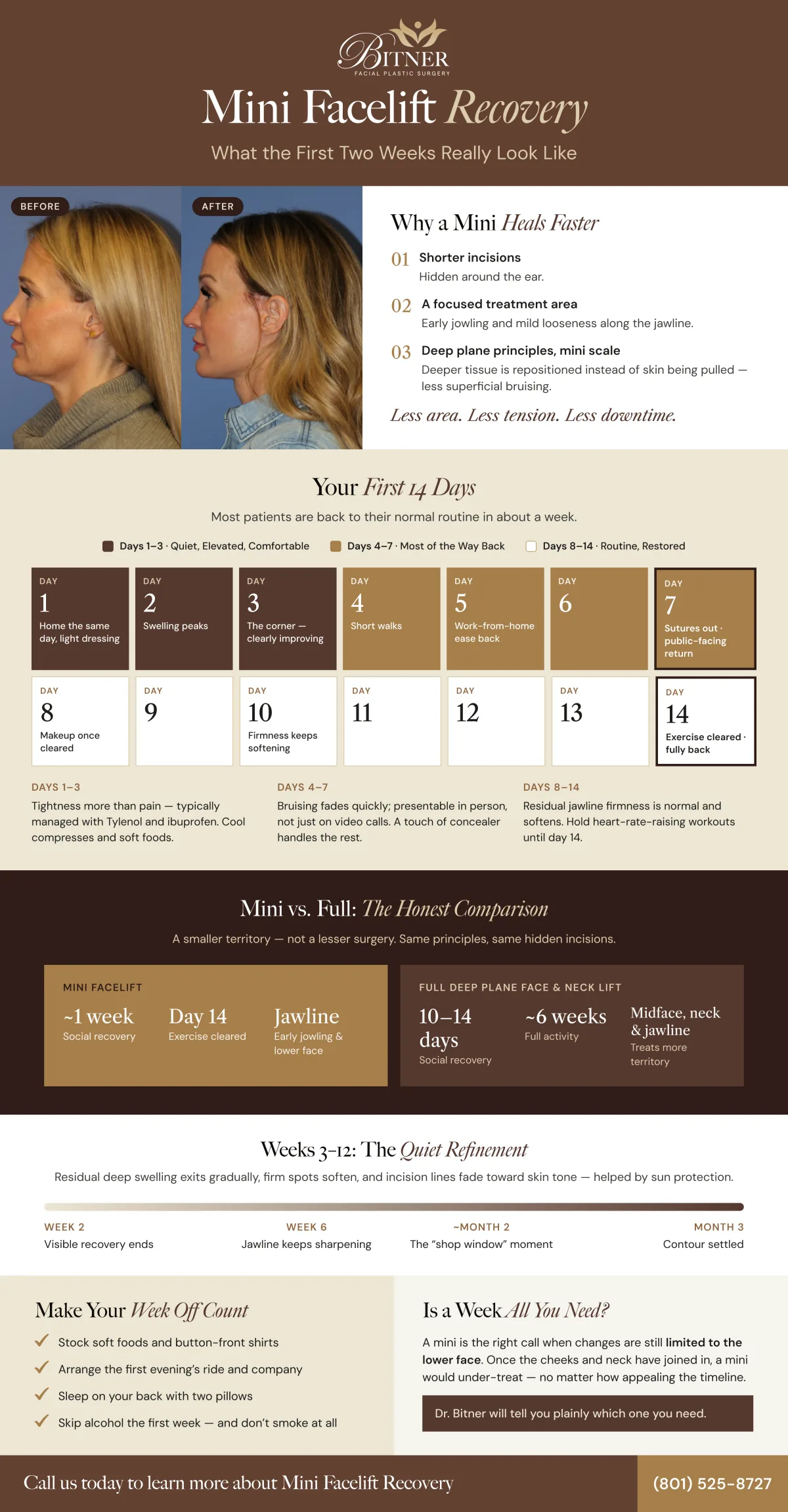
Most mini facelift patients are back to their normal routine in about a week — that short recovery is half the reason the procedure exists. Shorter incisions, a focused treatment area, and limited superficial dissection mean less swelling, less bruising, and a faster return to work and social life than a full facelift requires. Here’s what the first two weeks actually look like, day by day, for patients recovering from Dr. Bitner’s Rapid-Recovery Mini-Lift in Layton.
Why Mini Facelift Recovery Is Shorter
Recovery time tracks the extent of surgery. A mini facelift addresses early jowling and mild looseness along the jawline through shorter incisions hidden around the ear — a smaller surgical field than a full face and neck lift. Dr. Bitner’s version applies deep plane principles at mini-lift scale: the lift comes from repositioning deeper tissue rather than pulling skin, which limits the superficial trauma that causes prolonged bruising. Less area, less tension, less downtime. For patients whose aging has advanced beyond the lower face, the trade-off runs the other way — a deep plane facelift treats more and takes roughly 10 to 14 days of social recovery instead.
Days 1–3: Quiet, Elevated, Comfortable
You’ll head home the same day with a light dressing and instructions to rest with your head elevated. Swelling and mild bruising along the jawline peak around day two. Discomfort is genuinely modest — tightness more than pain — and typically managed with Tylenol and ibuprofen alone. Use cool compresses, eat soft foods if chewing feels tight, and keep your first follow-up appointment. Most patients describe day three as the corner: still puffy, but clearly improving.
Days 4–7: Most of the Way Back
By mid-week-one, bruising fades quickly and swelling recedes enough that you look presentable in person, not just on video calls. Short walks are encouraged. Patients working from home often ease back in around day four or five; sutures come out at about one week. If your job is public-facing, the end of week one is a realistic return date — a touch of concealer handles what’s left.
Days 8–14: Routine, Restored
The second week is about finishing quietly. Residual firmness along the jawline is normal and softens week by week. Makeup can typically cover any lingering discoloration once incisions have sealed and you’ve been cleared. Exercise is the one meaningful restriction that remains: hold off on workouts that raise your heart rate until day 14, then ramp up gradually. By the end of week two, most patients are fully back — dinners, meetings, photos — while the contour continues to refine over the following two to three months.
Making Your Week Off Count
Small preparations compress recovery further: stock soft foods and button-front shirts, arrange the first evening’s ride and company, sleep on your back with two pillows, skip alcohol for the first week, and don’t smoke at all — nicotine slows the healing this procedure is designed to shorten. And keep perspective on the calendar: one week of quiet in exchange for a jawline that reads years younger is the arithmetic that makes this procedure so popular with patients in their 40s and early 50s. And the practice publishes current mini facelift cost information openly, so the budget side of the plan is just as clear.
Is a Week of Downtime All You Need?
The honest answer depends on your anatomy. A mini lift with a mini recovery is the right call when changes are still limited to the lower face; when the cheeks and neck have joined in, a mini would under-treat the problem no matter how appealing the timeline. Dr. Bitner will tell you plainly which you need. Call (801) 525-8727 to schedule a consultation in Layton — your consultation fee is applied to the cost of your procedure.
Weeks 3–12: The Quiet Refinement Phase
The visible recovery ends around day fourteen; the invisible one keeps working for another two to three months, entirely in your favor. Residual deep swelling exits gradually, which is why the jawline you like at week two keeps sharpening at week six and again at week ten. Firm spots along the lifted tissue soften. Faint pink at the incision lines fades toward skin tone, helped considerably by consistent sun protection. Most patients report a specific moment — often around the two-month mark — when a photo or a passing shop window catches them off guard with how settled everything looks. Comparing your own progress against mini facelift before and after results from the practice helps calibrate expectations along the way.
How This Compares to Full Facelift Recovery
The honest comparison helps calibrate expectations. A full deep plane face and neck lift asks for roughly 10 to 14 days of social downtime and about six weeks to full activity, because it treats the midface and neck along with the jawline. The mini’s one-week social recovery and 14-day exercise clearance exist because the surgical field is smaller — not because the surgery is lesser. Same principles, same hidden incisions, same structural approach; a smaller territory, treated when the problem is still small. That’s the real logic of timing a mini lift well: catch the jawline early, and the easier recovery comes as part of the package.
Mini Facelift Recovery FAQs
When can I wear makeup after a mini facelift?
Once incisions have fully sealed and you’ve been cleared at your follow-up — commonly around the end of week one. Mineral or gentle formulations are easiest on healing skin, and most residual discoloration covers easily at that point.
Do mini facelift patients need drains or head wraps?
Dr. Bitner’s Rapid-Recovery Mini-Lift typically requires only a light dressing in the first days rather than bulky wraps, and drains are generally unnecessary given the limited dissection. Your specific aftercare instructions are confirmed on surgery day based on your procedure plan.
When are sutures removed after a mini facelift?
At approximately one week. That visit usually coincides with the transition back to normal routines — bruising has largely faded, swelling has settled substantially, and remaining care is simple incision protection while the contour refines.
Sources: 1. American Society of Plastic Surgeons — Facelift: https://www.plasticsurgery.org/cosmetic-procedures/facelift 2. Mayo Clinic — Face-lift: https://www.mayoclinic.org/tests-procedures/face-lift/about/pac-20394059