

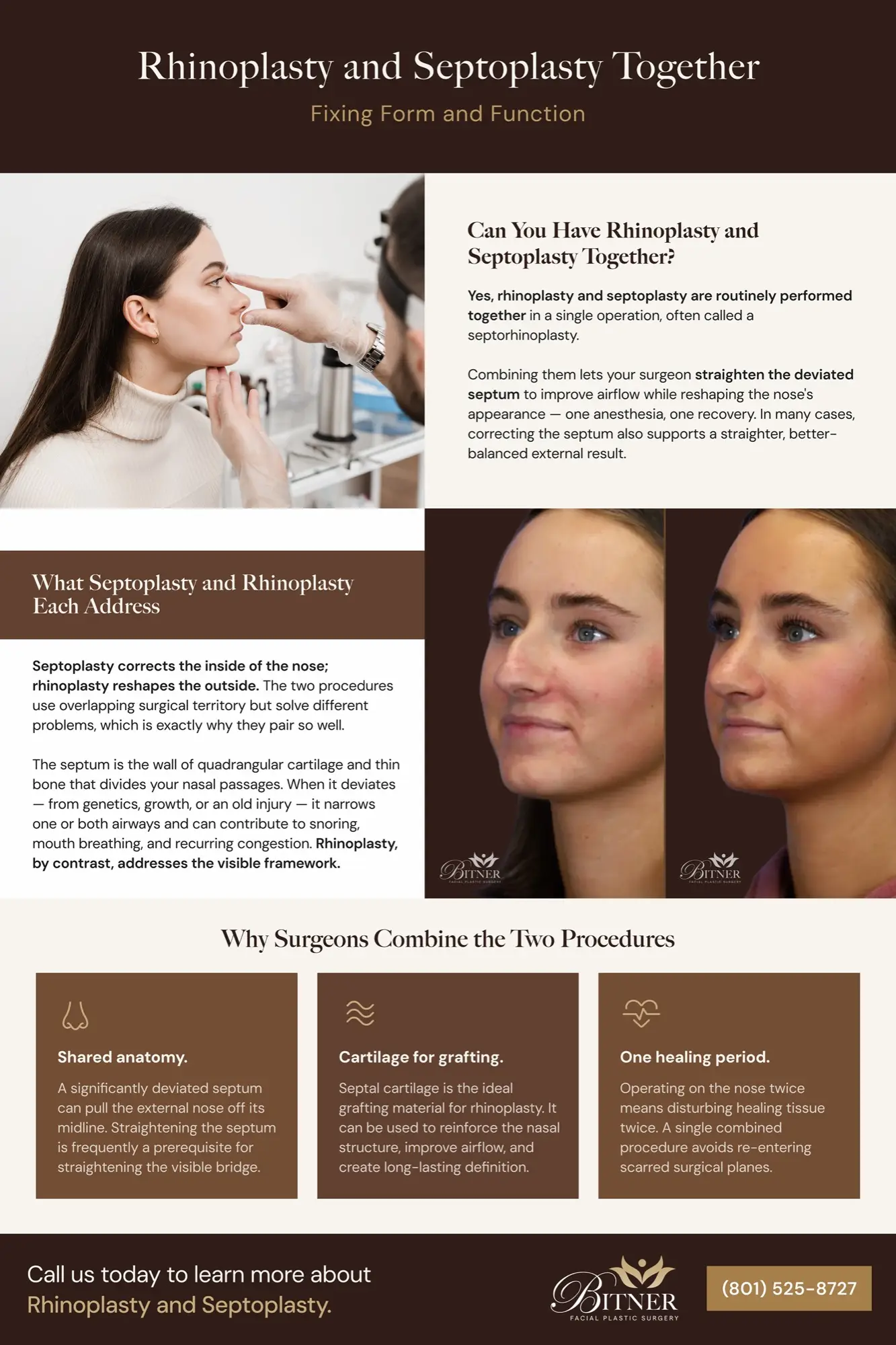
Yes, rhinoplasty and septoplasty are routinely performed together in a single operation, often called a septorhinoplasty. Combining them lets your surgeon straighten the deviated septum to improve airflow while reshaping the nose’s appearance — one anesthesia, one recovery. In many cases, correcting the septum also supports a straighter, better-balanced external result.
Medically reviewed by John Bitner, MD — Double Board-Certified Facial Plastic and Reconstructive Surgeon. Last updated: July 9, 2026.
Many patients arrive at their consultation with two complaints about the same nose: they do not like how it looks, and they cannot breathe well through it. Those problems often share a root cause — a deviated septum — and they can usually be corrected in one operation. At Dr. Bitner Facial Plastic Surgery, rhinoplasty and septoplasty are frequently combined so patients heal once rather than twice. Because Dr. Bitner trained in otolaryngology–head and neck surgery before completing his facial plastic surgery fellowship, he approaches every nose as both an airway and an aesthetic feature. This article explains what each procedure does, why combining them makes sense, how insurance treats the functional portion, and what recovery looks like.
What Septoplasty and Rhinoplasty Each Address
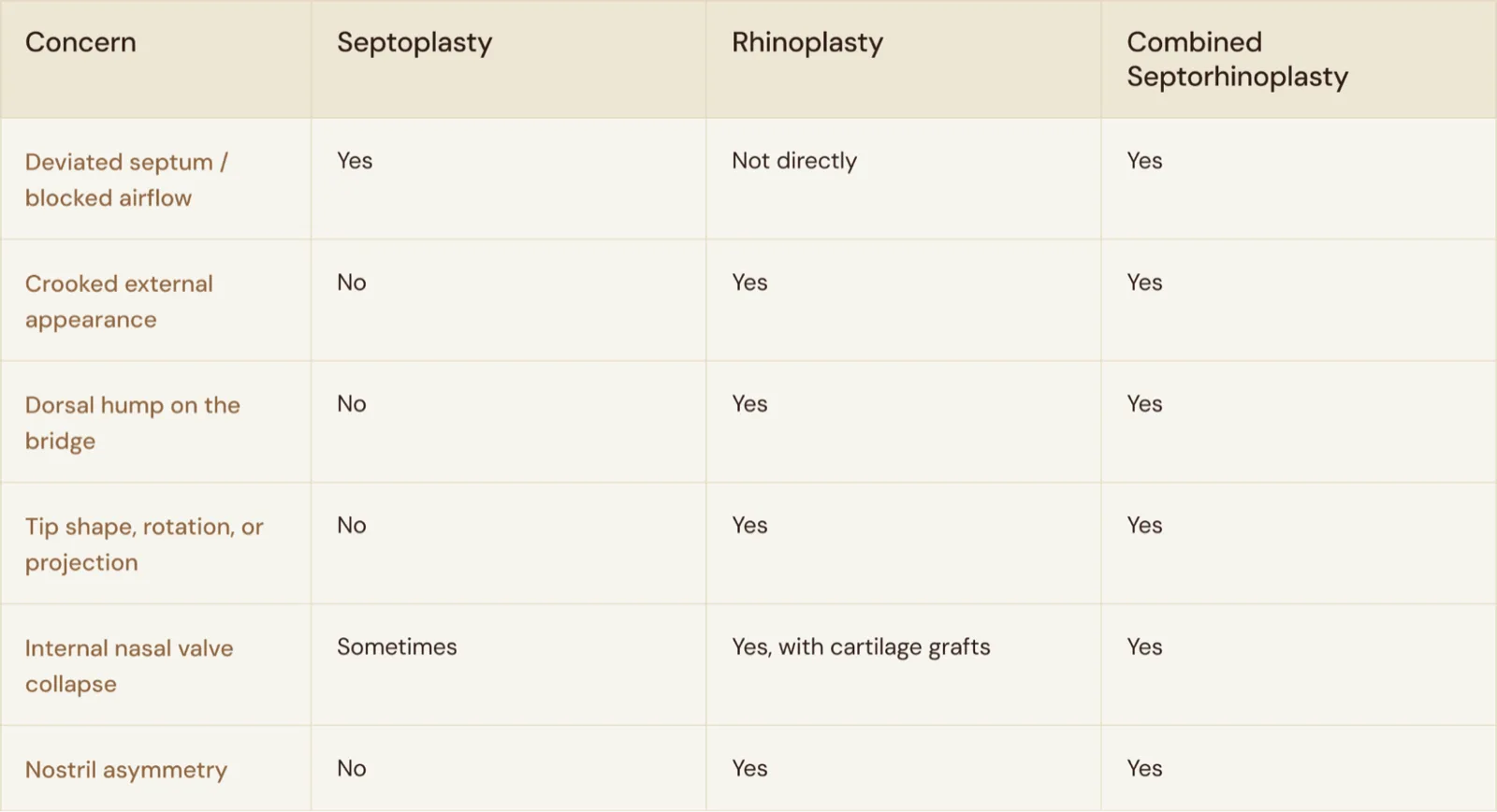
Septoplasty corrects the inside of the nose; rhinoplasty reshapes the outside. The two procedures use overlapping surgical territory but solve different problems, which is exactly why they pair so well.
The septum is the wall of quadrangular cartilage and thin bone that divides your nasal passages. When it deviates — from genetics, growth, or an old injury — it narrows one or both airways and can contribute to snoring, mouth breathing, and recurring congestion. Rhinoplasty, by contrast, addresses the visible framework: the nasal bones, the upper and lower lateral cartilages, and the tip.
Why Surgeons Combine the Two Procedures
Combining rhinoplasty and septoplasty means one anesthesia, one operation, and one recovery — and it often produces a better result than staging them. There are three practical reasons the procedures are performed together so often.
- Shared anatomy. A significantly deviated septum can pull the external nose off its midline. Straightening the septum is frequently a prerequisite for straightening the visible bridge.
- Cartilage for grafting. The septal cartilage removed during septoplasty is the preferred grafting material in rhinoplasty. Dr. Bitner uses it to build spreader grafts that hold the internal nasal valve open and tip grafts that create lasting definition — structure that supports both breathing and shape.
- One healing period. Operating on the nose twice means disturbing healing tissue twice. A single combined procedure avoids re-entering scarred surgical planes and spares you a second round of splints, swelling, and time off work.
Does Insurance Cover a Combined Procedure?
Insurance sometimes covers the functional portion of a combined surgery — the septoplasty — while the cosmetic rhinoplasty portion is not covered. Coverage depends entirely on your individual plan and on documentation of a medical need, so nothing here should be read as a guarantee.
When a deviated septum causes documented breathing obstruction, many plans classify septoplasty as medically necessary. Insurers typically want evidence such as an examination confirming the deviation, a history of persistent obstruction, and sometimes a record of conservative treatments — nasal steroid sprays, for example — that did not resolve the problem. Cosmetic changes to the bridge, tip, or nostrils are considered elective and are billed separately from any covered functional work.
Before scheduling, our team encourages every patient to verify benefits directly with their insurer and request the specific criteria for septoplasty coverage. For a plain-language look at how elective fees are structured, read our rhinoplasty cost breakdown or visit our overview of the cost of facial plastic surgery.
What Recovery Looks Like After Septorhinoplasty
Recovery after a combined procedure follows nearly the same timeline as rhinoplasty alone. The internal and external work heal simultaneously, so you do not add weeks by addressing both.
- Days 1–3: Expect congestion, grogginess, and mild oozing. Internal soft splints (if used) support the straightened septum; an external splint protects the reshaped bridge. Sleep with your head elevated.
- Days 5–7: The external splint and any internal splints are removed at your first follow-up visit. Bruising beneath the eyes begins to yellow and fade.
- Days 7–10: Most patients return to desk work and social activities, often with light makeup covering residual bruising.
- Weeks 2–3: Congestion improves noticeably as internal swelling subsides and breathing through the corrected airway becomes easier.
- Weeks 4–6: Light exercise resumes around week three or four; more strenuous activity and contact-risk sports wait until roughly week six, with Dr. Bitner’s clearance.
- Months 3–12: Residual swelling — especially in the tip — resolves gradually. Many patients notice their breathing improvement before their final cosmetic refinement fully emerges.
Who Is a Candidate for a Combined Procedure?
Good candidates have both a functional airway problem and a cosmetic goal, are in stable general health, and hold realistic expectations. Nasal growth should be complete, which typically means patients are in their mid-to-late teens or older.
During your consultation, Dr. Bitner examines the septum, the turbinates, and the internal nasal valves, then evaluates the external framework and reviews computer imaging of potential changes with you. If your concerns are purely functional, a septoplasty alone may be the right recommendation; if they are purely cosmetic, rhinoplasty alone may serve you better. The point of the evaluation is to match the operation to the actual problem — not to add procedures.
Frequently Asked Questions
Can you get a nose job and septoplasty at the same time?
Yes, a nose job and septoplasty can be performed at the same time in a single surgery called septorhinoplasty. Combining them means one anesthesia and one recovery period, and straightened septal cartilage often supports the cosmetic result. Dr. Bitner evaluates both breathing function and appearance during your consultation.
Does septoplasty change the shape of your nose?
Septoplasty alone typically does not change the outward shape of your nose. It straightens the internal wall of cartilage and bone that divides the nasal passages. Visible changes to the bridge, tip, or nostrils require rhinoplasty techniques, which is why many patients choose to combine the two procedures.
Is recovery longer when rhinoplasty and septoplasty are combined?
No, combining rhinoplasty and septoplasty does not meaningfully lengthen recovery. Both procedures heal on overlapping timelines: the external splint comes off around one week, congestion improves over two to three weeks, and most patients return to desk work within 7–10 days. One combined recovery is shorter than two separate ones.
Schedule a Consultation
If you struggle with both the appearance of your nose and your ability to breathe through it, a single combined procedure may address both. Dr. Bitner will examine your airway, discuss your aesthetic goals, and explain exactly what he recommends and why. Call (801) 525-8727 to schedule a consultation today — the $250 consultation fee is applied to the cost of your procedure.
Dr. Bitner Facial Plastic Surgery, 425 S 100 W, Layton, UT 84041