

Open rhinoplasty adds a small incision across the columella — the strip of tissue between the nostrils — giving the surgeon direct visibility of the entire nasal framework, while closed rhinoplasty places every incision inside the nostrils. Open suits complex tip work and revisions; closed suits more limited reshaping with no external scar.
Medically reviewed by John Bitner, MD — Double Board-Certified Facial Plastic and Reconstructive Surgeon. Last updated: July 27, 2026.
Patients often arrive at their consultation having already picked a side in the open-versus-closed debate — usually after a night of conflicting forum threads. Here is the perspective that matters: this is not a choice between a good technique and a bad one. Both are legitimate approaches to rhinoplasty, both are used by experienced surgeons, and the right one depends on what your nose needs. The open approach trades a tiny, well-hidden external incision for complete surgical visibility; the closed approach trades some visibility for zero external incisions and often a gentler early recovery. In this post, Dr. Bitner explains how each technique works, where each shines, and how he decides between them for a given nose.
What Is the Difference Between Open and Closed Rhinoplasty?
The difference comes down to one incision. Open rhinoplasty adds a small transcolumellar incision — a few millimeters across the columella, between the nostrils — that lets the surgeon lift the nasal skin and see the cartilage and bone framework directly. Closed rhinoplasty keeps every incision inside the nostrils.
Everything else about the two techniques flows from that single distinction. With the skin elevated in an open approach, the surgeon works on the lower lateral cartilages, the septum, and the nasal bones under direct vision, placing sutures and grafts with maximum precision. In the closed (endonasal) approach, the surgeon works through the nostrils, reshaping structures through smaller access points by feel and limited sight lines. Neither approach changes what can be seen from the outside during healing in any dramatic way — the open incision heals to a faint line that most people never notice — but each carries real trade-offs in exposure, swelling, and suitability for complex maneuvers.
How Open Rhinoplasty Works — and When It’s the Right Call
Open rhinoplasty is the technique of choice when the nasal tip needs significant reshaping, when structural grafts must be placed precisely, or when a previous surgery has to be revised. Direct visibility is its entire advantage, and for complex work that advantage is decisive.
After the transcolumellar incision joins the internal incisions, the skin envelope is lifted, and the entire framework — the paired lower lateral cartilages that shape the tip, the upper lateral cartilages, the septum, and the bony vault — is exposed. This allows the surgeon to:
- Reshape and suture the tip cartilages symmetrically under direct vision
- Place structural grafts (such as columellar struts or spreader grafts, which support breathing) with millimeter accuracy
- Diagnose and correct asymmetries that are invisible from outside
- Address scar tissue and distorted anatomy in revision cases
The trade-offs are modest but real: the columellar incision requires healing time, tip swelling lasts somewhat longer because more tissue is elevated, and the operation typically takes a bit longer. For noses that need meaningful structural work, those costs are small next to the benefit of operating with full sight of every cartilage edge and suture.
How Closed Rhinoplasty Works — and When It’s the Right Call
Closed rhinoplasty suits noses that need well-defined, more limited changes — most classically, reducing a dorsal hump — without major tip restructuring. All incisions stay hidden inside the nostrils, and less soft tissue is lifted, which tends to mean less early tip swelling.
Through endonasal incisions, the surgeon can remove or reduce a hump on the bridge, narrow the nasal bones with controlled osteotomies, make conservative refinements to the tip, and straighten portions of the septum. Patients drawn to the closed approach appreciate:
- No external incision of any kind
- Often milder swelling in the first weeks, since the skin envelope is disturbed less
- Somewhat shorter operating time for suitable cases
The limitation is exposure. Working through the nostrils narrows what the surgeon can see and suture, which is why most surgeons reserve the closed approach for noses that do not need complex tip work, significant grafting, or revision of prior surgery.
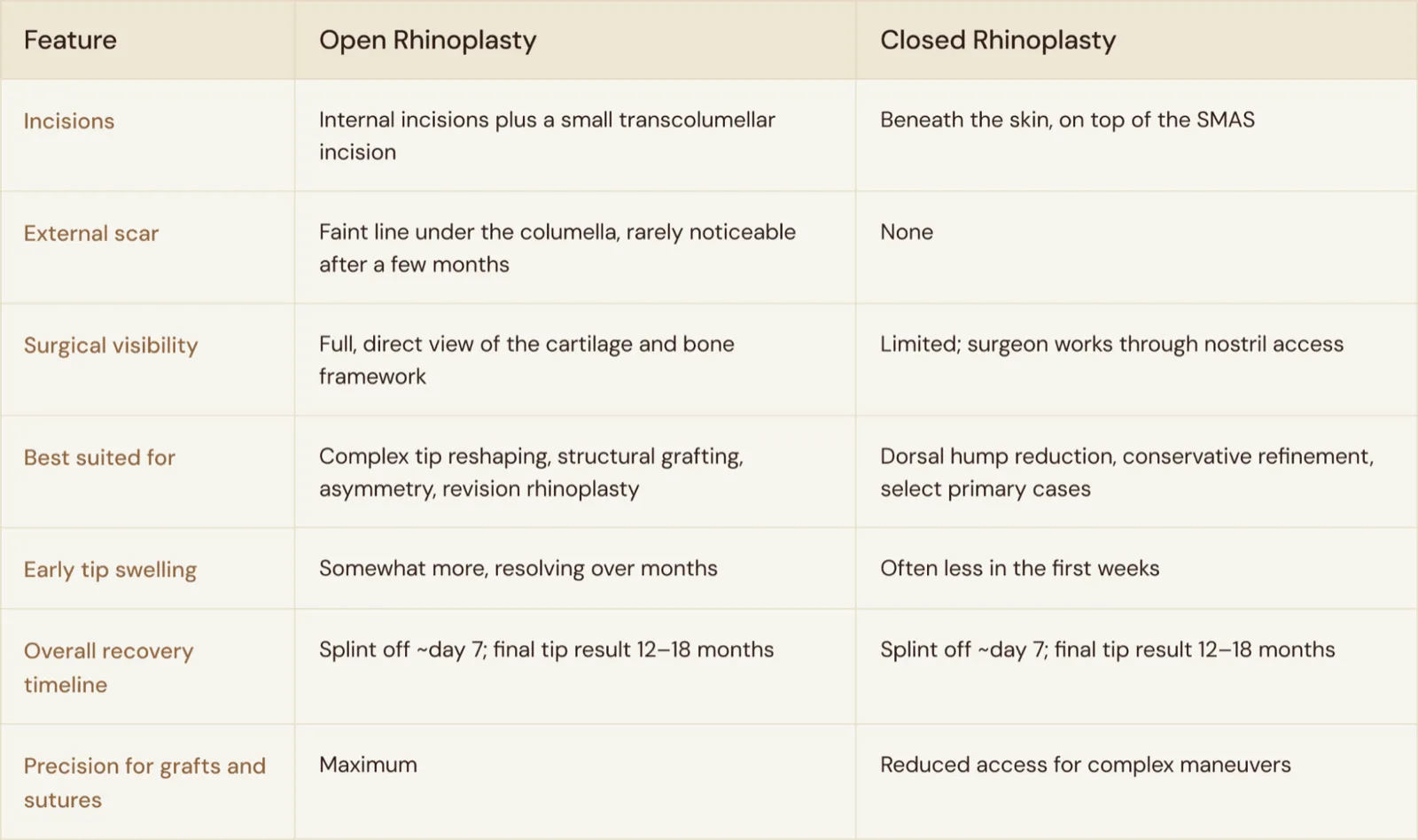
Open vs. Closed Rhinoplasty: Side-by-Side Comparison
Seeing the trade-offs side by side makes the decision framework clear. Neither column is “better” — each is better for certain noses.
Does the Open Incision Leave a Noticeable Scar?
For the overwhelming majority of patients, no — the columellar scar heals to a faint, pale line on the underside of the nose that is invisible in normal interaction. Someone would need to tilt your head back and look for it deliberately.
The incision is only a few millimeters long, sits in shadow beneath the nasal tip, and is typically closed with fine sutures under no tension. It passes through its usual healing stages — slightly pink for the first several weeks, fading steadily over three to six months. Scar concerns are a reasonable thing to raise at consultation, but they should not drive the technique decision by themselves; choosing limited exposure for a nose that needs complex work is a much larger aesthetic risk than a hidden 4-millimeter line.
How Dr. Bitner Chooses the Technique for Your Nose
The technique follows the surgical plan — never the other way around. At consultation, Dr. Bitner examines your nasal framework, skin thickness, breathing, and goals, then selects the approach that lets him execute your specific plan with the most control.
In practice, that means the decision rests on questions like: How much tip refinement do you want? Is there asymmetry that needs direct correction? Will your breathing benefit from spreader grafts or septal work? Is this a revision? Skin thickness matters too — thicker, more sebaceous skin swells longer and can benefit from the precise framework control the open approach provides, while thin skin shows every contour and rewards the lighter touch of either technique done conservatively. A surgeon who performs both — and who has spent more than 16 years operating exclusively on the face — can match the approach to the anatomy rather than defaulting to a favorite.
Whichever technique is chosen, the recovery road map is nearly identical: an external splint for about a week, social presentability in 7–10 days, staged return to exercise over four to six weeks, and final tip definition at 12–18 months. You can review healed results from both approaches in our photo gallery, and you may find it hard to tell which technique was used. That is the point. Patients often return for follow-up procedures or refer loved ones because of the trust they’ve built.
Frequently Asked Questions
What is the difference between open and closed rhinoplasty?
Open rhinoplasty adds a small incision across the columella, the strip of tissue between the nostrils, allowing the surgeon to lift the skin and see the entire nasal framework directly. Closed rhinoplasty places every incision inside the nostrils, leaving no external scar but offering more limited visibility.
Does open rhinoplasty leave a visible scar?
Open rhinoplasty leaves a scar so small that most people never notice it. The incision sits on the underside of the columella between the nostrils, measures only a few millimeters, and typically fades to a faint line within a few months of surgery. It is not visible in ordinary conversation.
Is recovery faster with closed rhinoplasty?
Closed rhinoplasty often produces less early tip swelling, so the first weeks of recovery can look slightly easier. The overall timeline, however, is similar for both techniques: about a week in a splint, 7–10 days of social downtime, and 12–18 months for final tip refinement.
Schedule a Consultation
The open-versus-closed question answers itself once a surgeon has examined your nose and understood your goals. Dr. Bitner will walk you through his recommended approach and exactly why it fits your anatomy. Call (801) 525-8727 to schedule a consultation today — the $250 consultation fee is applied to the cost of your procedure.
Dr. Bitner Facial Plastic Surgery, 425 S 100 W, Layton, UT 84041