

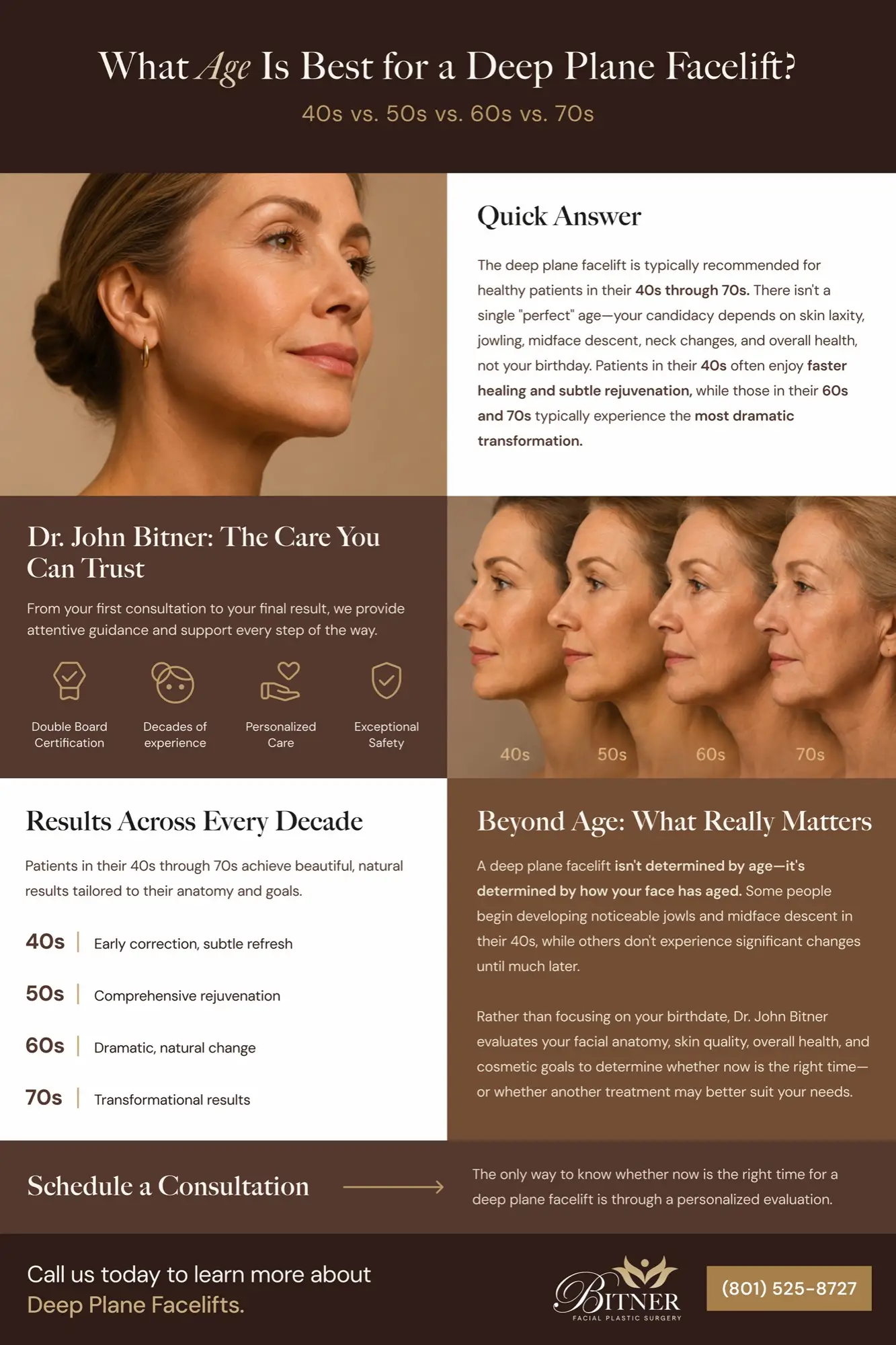
The deep plane facelift is typically recommended for patients in their 40s through 70s. There is no single ideal age — candidacy depends on skin laxity, jowling, midface descent, and overall health rather than a birthday. Patients in their 40s often heal faster with subtler needs, while patients in their 60s and 70s see the most dramatic change.
Medically reviewed by John Bitner, MD — Double Board-Certified Facial Plastic and Reconstructive Surgeon. Last updated: July 23, 2026.
“Am I too young for this?” and “Did I wait too long?” are two versions of the same question, and Dr. Bitner hears both nearly every week. The reassuring answer is that the deep plane facelift has a wide candidacy window — patients in their 40s through their 70s are routinely excellent candidates — and the deciding factors are anatomical, not numerical. What matters is what has happened in your face: how far the midface has descended, how much the jawline has softened, how the neck has changed, and how well your skin will heal. This guide walks through what the procedure accomplishes decade by decade, so you can see where your own reflection fits — and when a smaller procedure might serve you better.
Is There a “Best” Age for a Deep Plane Facelift?
No — there is a best stage, not a best age. The deep plane facelift is typically recommended for patients in their 40s through 70s, and within that window, the right timing is when the anatomical changes the procedure corrects have actually arrived.
Those changes are specific. The deep plane technique releases the facial retaining ligaments and repositions the descended midface, jowls, and neck as a composite unit of skin and SMAS. If those structures have not yet descended meaningfully, the procedure has little to reposition. If they have, your age matters far less than your health. Chronological age is a poor proxy for facial aging anyway: genetics, sun exposure, weight fluctuations, smoking history, and bone structure can put one 45-year-old and one 60-year-old in the same anatomical position. That is why Dr. Bitner evaluates faces, not birthdates, at consultation.
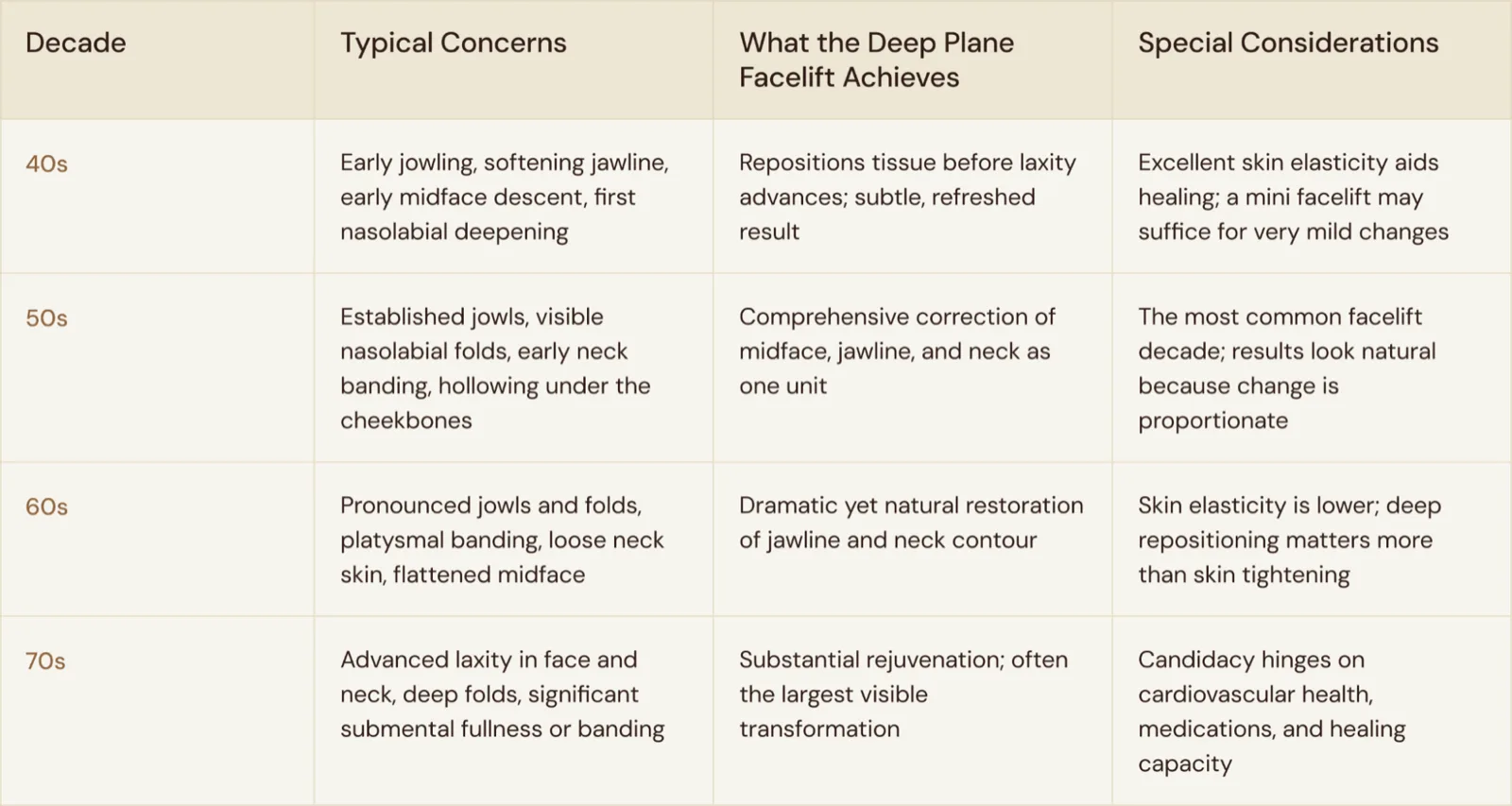
What a Deep Plane Facelift Addresses by Decade
The chart below summarizes what typically brings patients in at each stage of life, and what the procedure accomplishes for them. Your pattern may differ — these are the most common presentations.
The Deep Plane Facelift in Your 40s: Earlier Than You Think, Later Than You Fear
Patients in their 40s are not “too young” — they are simply early-stage candidates, and the deep plane technique serves them well when jowling and midface descent have clearly begun. The advantage of surgery at this stage is that excellent skin elasticity produces smooth healing and a result that reads as “well-rested,” not “operated on.”
There is a real fork in the road at this age, though. If your changes are limited to slight jawline blurring and mild laxity, a mini facelift — a smaller procedure with a shorter recovery — may be the more proportionate choice, reserving the full deep plane approach for later decades. Signs that point toward the full procedure even in your 40s include:
- Jowls visible in photographs, not just in the mirror at certain angles
- Midface descent that has deepened the nasolabial folds
- Early neck laxity or fullness beneath the chin
- A family pattern of early, significant facial aging
Dr. Bitner will tell you plainly if you are a better candidate for the smaller procedure — recommending the right operation, not the biggest one, is the foundation of a practice built on long-term relationships.
The Deep Plane Facelift in Your 50s: The Most Common Decade
The 50s are the most common decade for a deep plane facelift, and for good reason: the anatomical changes the procedure corrects are now fully established, while skin quality and overall health typically remain strong. This combination produces some of the most satisfying results in facial surgery.
By the mid-50s, most patients have descended midface fat compartments, defined jowls interrupting the jawline, and the beginnings of platysmal banding in the neck. Because the deep plane technique repositions all of these as one composite flap — rather than tightening skin over them — the correction is comprehensive and the healing tension sits on strong deep tissue. Patients in this decade also benefit most from the longevity math: most facelifts last 8–12 years, with the deep plane at the upper end of that range, which means a lift at 55 can carry a patient well into their 60s before aging meaningfully re-accumulates.
The Deep Plane Facelift in Your 60s and 70s: Dramatic, Natural Change
Healthy patients in their 60s and 70s are excellent deep plane candidates, and they often see the most dramatic transformations of any age group. The procedure was in many ways built for this stage: when laxity is advanced, skin-tension techniques fall short, and repositioning the deep structures is the only approach that restores the jawline and neck convincingly.
At this stage the evaluation appropriately shifts toward health rather than anatomy. Dr. Bitner reviews cardiovascular status, medications (particularly blood thinners), and healing history, and coordinates with your primary care physician when appropriate. Age alone does not disqualify anyone — a fit 72-year-old is frequently a better surgical candidate than a 55-year-old with unmanaged health conditions. Recovery in these decades follows the same arc as for younger patients — social presentability around days 10–14, full activity by weeks four to six — sometimes with an extra week or two of swelling resolution. Skin with less elastin simply takes a little longer to settle over the repositioned deep structures, which is a scheduling consideration, not a barrier. The reward is proportionate: restoring a clean neckline and jawline after decades of change is among the most gratifying outcomes in facial plastic surgery. Many patients in this group pair the procedure with upper eyelid or brow rejuvenation for a balanced result, a combination Dr. Bitner evaluates case by case. You can see healed results across every decade in our photo gallery.
Signs You’re Ready — at Any Age
Readiness for a deep plane facelift is anatomical, emotional, and practical all at once. The clearest sign is that the changes you see now bother you consistently — not just in one bad photo — and that nonsurgical options have stopped delivering.
Consider scheduling an evaluation when:
- Jowls, nasolabial folds, or neck laxity are visible in everyday photos
- Fillers and skin treatments no longer produce the improvement you want
- You are in good general health and can set aside two weeks of social downtime
- Your motivation is your own — looking like yourself, a decade fresher
Patients often return for follow-up procedures or refer loved ones because of the trust they’ve built.
Frequently Asked Questions
What is the best age for a deep plane facelift?
Most deep plane facelift patients are between their 40s and 70s. There is no single ideal age; the right timing depends on skin laxity, jowling, midface descent, and overall health rather than a birthday. Patients with earlier, milder changes are often better served by a mini facelift.
Am I too young for a deep plane facelift in my 40s?
No — many patients in their 40s are excellent deep plane facelift candidates. Patients this age typically have early jowling and midface descent with good skin elasticity, which supports smooth healing and long-lasting results. If your changes are still very mild, a mini facelift may be the more proportionate option.
Is 70 too old for a deep plane facelift?
No, 70 is not too old for a deep plane facelift. Healthy patients in their 70s undergo the procedure safely and see dramatic improvement in jowls, deep folds, and neck laxity. Candidacy depends on cardiovascular health, medications, and healing capacity — factors Dr. Bitner evaluates at your consultation.
Schedule a Consultation
The only way to know where your face sits on this timeline is an in-person evaluation. Dr. Bitner has devoted his practice exclusively to the face for more than 16 years, and he will give you a candid assessment — whether that means a deep plane facelift now, a smaller procedure first, or waiting altogether. Call (801) 525-8727 to schedule a consultation today — the $250 consultation fee is applied to the cost of your procedure.
Dr. Bitner Facial Plastic Surgery, 425 S 100 W, Layton, UT 84041