

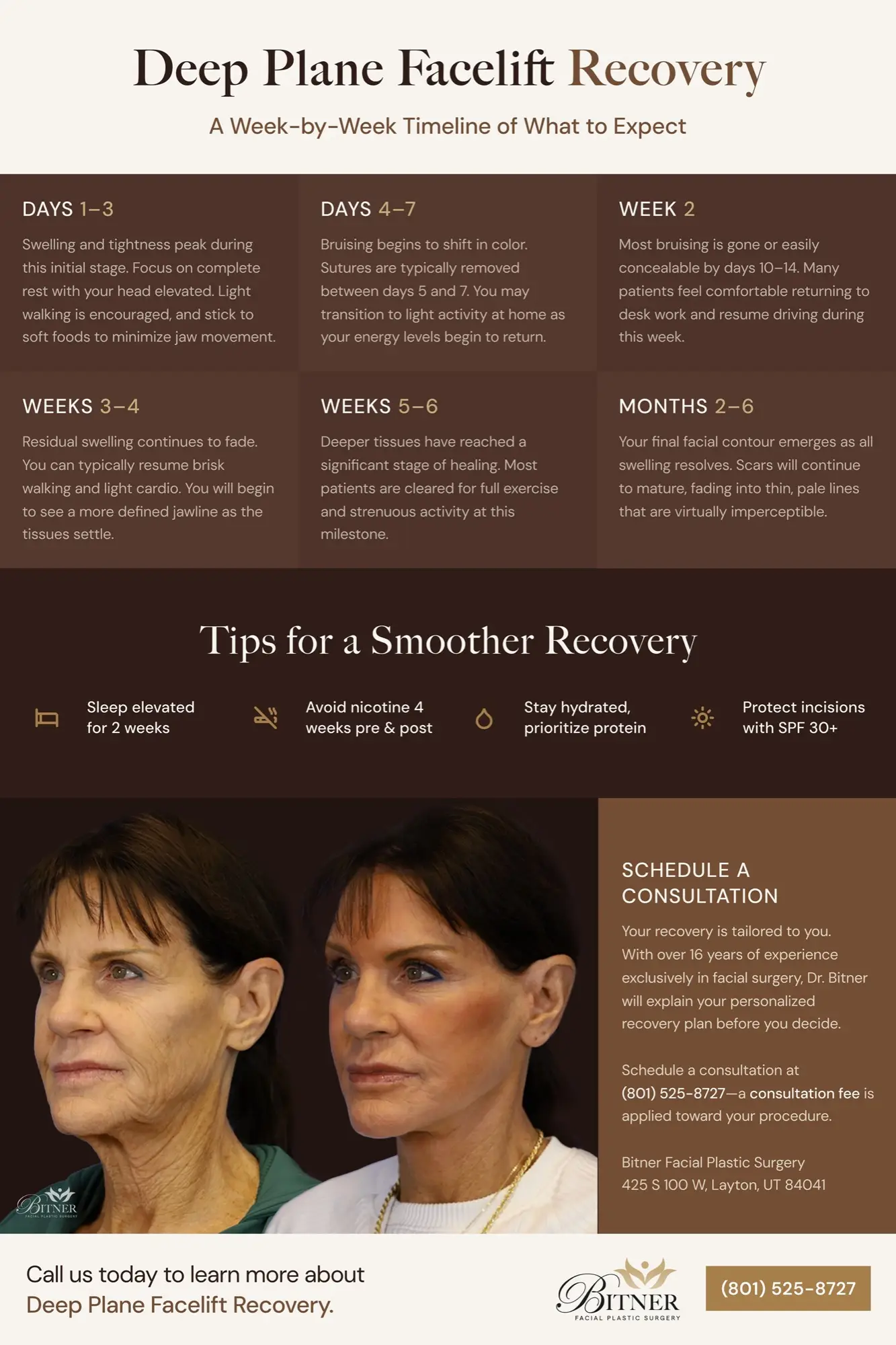
Most patients recover from a deep plane facelift within four to six weeks. Swelling and bruising peak in the first 72 hours, most people look socially presentable by days 10–14, light exercise resumes around week three, and residual swelling continues to fade over three to six months as the final result emerges.
Medically reviewed by John Bitner, MD — Double Board-Certified Facial Plastic and Reconstructive Surgeon. Last updated: July 13, 2026.
If you are researching a deep plane facelift, the first question is usually about the result — and the second, almost immediately, is about the recovery. How many days off work? When does the bruising fade? When can you walk into a room without anyone suspecting you had surgery? At Dr. Bitner Facial Plastic Surgery in Layton, Utah, we walk every patient through this timeline before surgery, because knowing what is normal on day 3 versus day 13 removes most of the anxiety from healing. A deep plane facelift repositions the deeper structural layer of the face — the SMAS, or superficial musculoaponeurotic system — rather than simply tightening skin, and that difference shapes the entire recovery experience. Below is the week-by-week timeline Dr. Bitner’s patients follow, along with the milestones that tell you healing is on track.
How Long Does Recovery From a Deep Plane Facelift Take?
Most patients feel recovered from a deep plane facelift in four to six weeks, and they look socially presentable well before that — typically by days 10 to 14. Full exercise usually resumes between weeks four and six, while subtle deep swelling continues to resolve for three to six months.
It helps to think of recovery in three overlapping phases. The acute phase covers the first week, when swelling, bruising, and tightness are at their peak and your job is simply to rest and follow instructions. The social recovery phase spans weeks two and three, when most patients return to desk work, errands, and low-key gatherings. The full recovery phase runs through weeks four to six, when exercise restrictions lift and the face begins to feel like your own again. After that, healing continues quietly beneath the surface: incision lines mature, residual firmness softens, and the final contour settles in over several months.
Deep Plane Facelift Recovery: Week-by-Week Timeline
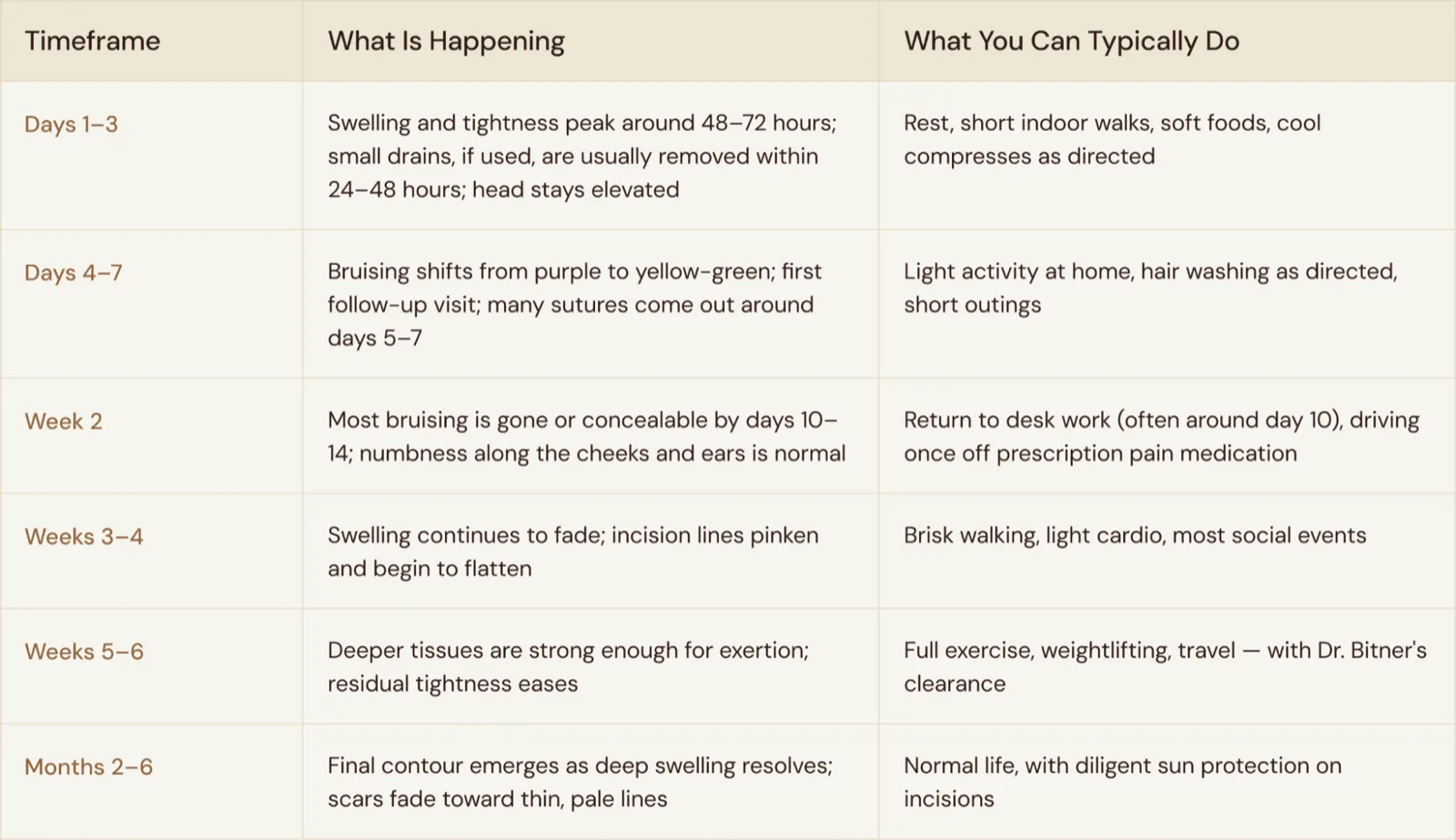
Here is the timeline at a glance. Individual healing varies, so treat these ranges as typical milestones rather than deadlines.
The First 72 Hours: Swelling, Tightness, and Rest
The first three days are dominated by swelling and a sensation of tightness — not, for most patients, significant pain. Swelling typically peaks between 48 and 72 hours after surgery, then begins a steady decline.
You will go home (or to your aftercare arrangement) with a soft compressive dressing around the face and neck. If Dr. Bitner places small drains to prevent fluid collection, they are usually removed at your first follow-up visit within a day or two. Your responsibilities during this window are simple but important:
- Keep your head elevated at roughly 30–45 degrees, including while sleeping, to reduce swelling.
- Take short, gentle walks around the house several times a day to support circulation.
- Stick to soft foods that do not require wide jaw opening.
- Avoid bending over, lifting, or straining, all of which raise blood pressure in the face.
- Call the office promptly if you notice sudden, one-sided swelling or escalating pain, which can signal a hematoma — a collection of blood that needs prompt attention.
Most patients describe this stage as pressure and stiffness rather than pain, and many manage comfortably with only a short course of medication.
Week 1: Bruising Fades and Sutures Come Out
By the end of the first week, the hardest part is behind you. Bruising begins changing color around days 4 and 5 — a sign it is breaking down — and many of your sutures are removed between days 5 and 10.
Numbness across the cheeks, jawline, and around the ears is expected at this stage. The small sensory nerve endings in the skin are temporarily quieted by surgery, and sensation returns gradually over weeks to months. Patients are often surprised that this numbness actually makes the first weeks more comfortable. You will also have your incisions checked at follow-up visits; deep plane incisions are placed along the natural creases of the ear and into the hairline, where they are designed to become inconspicuous as they mature.
Weeks 2–3: Back to Work and Social Life
Most patients with desk jobs return to work between days 10 and 14, and many feel comfortable at casual social events by the end of week two. Bruising that lingers is usually low on the neck and easy to conceal with clothing or makeup once incisions have closed.
This is the stage when patients start to catch glimpses of the result — a cleaner jawline in the mirror, a smoother neck in photographs — even though swelling is still masking the finer details. Light activity is encouraged, but hold off on anything strenuous: elevated heart rate and blood pressure too early can prolong swelling. Brisk walking and light cardio typically resume around week three with Dr. Bitner’s approval.
Weeks 4–6 and Beyond: Full Activity and the Final Result
By weeks four to six, most patients are cleared for unrestricted exercise and feel largely back to normal. The deeper tissue repair — the repositioned SMAS layer and released retaining ligaments — has gained enough strength to tolerate full exertion.
From here, the changes are gradual and rewarding. Residual deep swelling, most noticeable along the jawline and midface, resolves over three to six months, revealing the final contour. Incision lines fade from pink to pale over the course of the first year. And because the deep plane technique repositions the structural layer of the face rather than stretching skin, the result is built to endure: most facelifts last 8–12 years, with the deep plane technique at the upper end of that range. Patients often return for follow-up procedures or refer loved ones because of the trust they’ve built.
A Note on Cost and Recovery Planning
Cost is a natural part of planning for surgery and recovery time, and it varies with each patient’s surgical plan. Rather than quoting figures, we encourage you to read why the deep plane facelift is considered the gold standard and to review our overview of the cost of facial plastic surgery, then discuss your specific quote at a consultation.
Tips for a Smoother Deep Plane Facelift Recovery
The patients who sail through recovery tend to follow the same habits. Small daily choices in the first two weeks make a measurable difference in swelling and comfort.
- Sleep on your back with your head elevated for the first two weeks.
- Avoid nicotine in all forms for at least four weeks before and after surgery — it restricts blood flow to healing skin.
- Hold all blood-thinning medications and supplements exactly as instructed in your pre-op plan, and resume them only when cleared.
- Prioritize hydration and protein to fuel tissue repair.
- Protect incisions from the sun with SPF 30 or higher once they have healed, since ultraviolet exposure can darken immature scars.
- Give yourself grace on the timeline — swelling resolves on its own schedule, and week six looks dramatically better than week two.
Frequently Asked Questions
How long does it take to recover from a deep plane facelift?
Most patients recover from a deep plane facelift in four to six weeks. Bruising typically fades within 10–14 days, most people return to desk work around day 10, and light exercise resumes by week three. Residual swelling continues to soften over three to six months as final results settle.
When can I exercise after a deep plane facelift?
Light walking is encouraged within a day or two of surgery. Most patients resume brisk walking and light cardio around week three, and full workouts — including weightlifting and high-intensity exercise — by weeks four to six, once Dr. Bitner confirms the deeper tissues have healed enough to tolerate elevated blood pressure.
How long does swelling last after a deep plane facelift?
Most visible swelling resolves within two to three weeks of a deep plane facelift. Swelling peaks around days two to three, improves noticeably by the end of week one, and looks presentable by days 10–14. Subtle residual swelling, mostly along the jawline and midface, fades over three to six months.
Schedule a Consultation
Every recovery timeline starts with a surgical plan built around your anatomy and your calendar. Dr. Bitner has devoted his practice exclusively to the face for more than 16 years, and he will walk you through exactly what your recovery will look like before you commit to anything. Call (801) 525-8727 to schedule a consultation today — the consultation fee is applied to the cost of your procedure.
Dr. Bitner Facial Plastic Surgery, 425 S 100 W, Layton, UT 84041