

A deep plane facelift releases the facial retaining ligaments and repositions the skin and SMAS together as a single unit, while a SMAS facelift lifts the skin separately and tightens the SMAS by folding, suturing, or trimming it. The deep plane approach shifts tension to deeper tissue, improving the midface and avoiding a pulled look.
Medically reviewed by John Bitner, MD — Double Board-Certified Facial Plastic and Reconstructive Surgeon. Last updated: July 20, 2026.
If you have spent any time researching facelifts, you have run into these two terms — and probably a dozen conflicting explanations of them. The confusion is understandable: both techniques work on the same anatomical layer, and both are performed by qualified surgeons every day. The difference lies in what each technique does with that layer. Dr. Bitner performs the deep plane facelift as his primary rejuvenation technique, and in this post he explains — in plain anatomical terms — how it differs from a traditional SMAS lift, what those differences mean for your result, and how to think about which approach fits your face. For broader context on lifting options, our facelift overview covers the full spectrum of techniques.
What Is the SMAS, and Why Does Every Facelift Involve It?
The SMAS — superficial musculoaponeurotic system — is a continuous sheet of muscle and fibrous tissue that sits just beneath the facial skin and fat, and it is the structural layer every modern facelift manipulates. When the SMAS descends with age, it produces jowls, deepened nasolabial folds, and a softened jawline.
The SMAS connects upward to the temporal fascia, downward to the platysma muscle of the neck, and it is anchored to the facial skeleton by retaining ligaments — the zygomatic ligaments over the cheekbone, the masseteric ligaments along the cheek, and the mandibular ligaments near the chin. Surgeons abandoned skin-only lifting decades ago because skin stretches and recoils; it cannot hold repositioned facial weight. Durable lifting requires moving the SMAS itself. The question that separates the two techniques is how the SMAS gets moved — and whether those anchoring ligaments are released or left in place.
How a SMAS Facelift Works
A SMAS facelift lifts the skin off the face as one layer, then tightens the exposed SMAS as a second, separate step. The two layers are handled independently and pulled in their own directions.
There are several variations of this approach. In SMAS plication, the surgeon folds the SMAS onto itself and secures it with sutures. In SMAS imbrication or SMASectomy, a strip of SMAS is removed and the cut edges are sutured together. All of them share two features: the retaining ligaments are largely left intact, and the skin — separated from its deeper support — is redraped and trimmed under some tension. In experienced hands, SMAS techniques reliably improve the jawline and jowls. Their main limitation is reach: because the ligaments still tether the tissue, the lift has less effect on the midface and the nasolabial folds, and the separately tightened skin carries more of the closing tension.
How a Deep Plane Facelift Works
A deep plane facelift enters the plane beneath the SMAS, surgically releases the retaining ligaments, and then repositions the skin and SMAS together as one composite flap. Nothing is folded or trimmed away at the structural level — the entire fallen unit is lifted back to where it sat years earlier.
Releasing the zygomatic and masseteric ligaments is the key maneuver. Once those tethers are freed, the midface — the cheek fat pads that have slid downward — can be elevated vertically, softening the nasolabial folds in a way SMAS-only tightening cannot. Because skin and SMAS travel together, the skin is never stretched independently; the tension of the repair is carried entirely by the strong deep layer. Dr. Bitner typically pairs this with deep management of the neck through the platysma, which is why the procedure at our practice is a deep plane face and neck lift. Working beneath the SMAS demands detailed command of facial nerve anatomy, since the nerve branches run in adjacent planes — this is a technique built on surgical experience, not one that can be approximated.
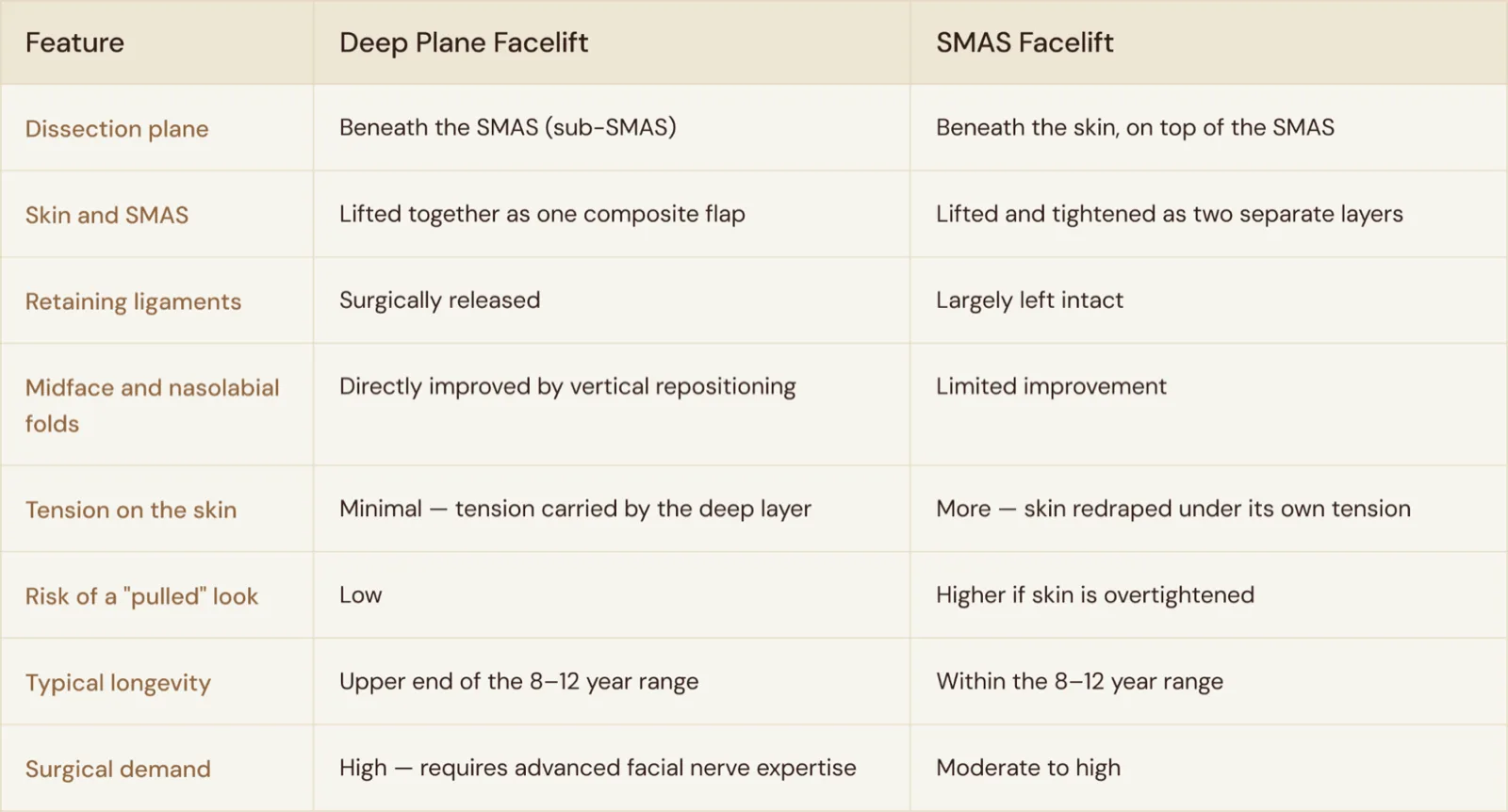
Deep Plane vs. SMAS Facelift: Side-by-Side Comparison
The clearest way to see the distinction is side by side. Both operate on the SMAS; they differ in dissection plane, ligament handling, and where the tension goes.
Which Technique Produces Better, Longer-Lasting Results?
Most facelifts last 8–12 years, with the deep plane technique at the upper end of that range — because repositioned deep tissue holds its position far better than tightened skin. The deep plane also has a structural advantage in naturalness: with no independent skin tension, there is nothing to create the windswept look associated with older lifting.
That said, a technique is only as good as the surgeon performing it, and a meticulous SMAS lift will outperform a poorly executed deep plane lift every time. The fair comparison is between well-performed versions of each: the deep plane addresses more of the aging face (midface, jawline, and neck as a unit), places healing tension where tissue can bear it, and preserves more of the skin’s blood supply because the skin is never widely separated from the layer that nourishes it. Those are the reasons it has become the leading choice among facial plastic surgeons who focus on facial rejuvenation — a case we lay out fully in why the deep plane facelift is considered the gold standard.
Recovery, notably, is not the trade-off many patients assume. Despite working in a deeper plane, the deep plane facelift heals on a comparable schedule — most patients look socially presentable within 10–14 days and resume full exercise by weeks four to six — and often with less bruising than expected, because the skin is never widely undermined. Reduced skin tension also tends to mean finer, flatter incision lines around the ears once healing matures over the first year.
How to Decide What Is Right for Your Face
The right technique depends on your anatomy — the degree of jowling, midface descent, and neck laxity you have — and on the experience of the surgeon evaluating you. No blog post can substitute for an in-person examination.
A few useful guideposts as you research:
- If your primary concerns are the midface, nasolabial folds, jowls, and neck together, the deep plane’s composite repositioning addresses all of them in one operation.
- If your aging changes are early and mild, a smaller procedure may be more proportionate than either full technique — ask about the full range of options.
- Ask any surgeon you consult which technique they perform, how often, and why. The answer reveals more than any brochure.
- Review healed results in a practice’s photo gallery, paying attention to whether patients look refreshed rather than tight.
Dr. Bitner has devoted his practice exclusively to the face for more than 16 years, and the deep plane face and neck lift is the centerpiece of that work. Patients often return for follow-up procedures or refer loved ones because of the trust they’ve built.
Frequently Asked Questions
What is the difference between a deep plane and SMAS facelift?
A deep plane facelift releases the facial retaining ligaments and repositions the skin and SMAS together as one composite flap, while a SMAS facelift lifts the skin separately and then tightens the SMAS by folding or trimming it. The deep plane approach places tension on deeper tissue rather than skin.
Is a deep plane facelift safer than a SMAS facelift?
Both techniques are safe in experienced hands, and neither is categorically safer. The deep plane approach works beneath the SMAS near the facial nerve branches, so it demands advanced anatomical expertise, but it also preserves more of the skin’s blood supply, which supports healing. Surgeon experience matters more than technique.
Does a deep plane facelift look more natural than a SMAS facelift?
A deep plane facelift is widely regarded as producing a very natural result. Because the skin and SMAS move together without separate skin tension, it avoids the tight, pulled appearance associated with older techniques. A well-performed SMAS lift can also look natural; outcomes depend heavily on the surgeon.
Schedule a Consultation
The technique conversation becomes much simpler when a surgeon is examining your face rather than a diagram. Dr. Bitner will assess your midface, jawline, and neck, explain what each approach would and would not accomplish for your anatomy, and give you a specific recommendation. Call (801) 525-8727 to schedule a consultation today — the $250 consultation fee is applied to the cost of your procedure.
Dr. Bitner Facial Plastic Surgery, 425 S 100 W, Layton, UT 84041