

Medically reviewed by John Bitner, MD — Double Board-Certified Facial Plastic and Reconstructive Surgeon.
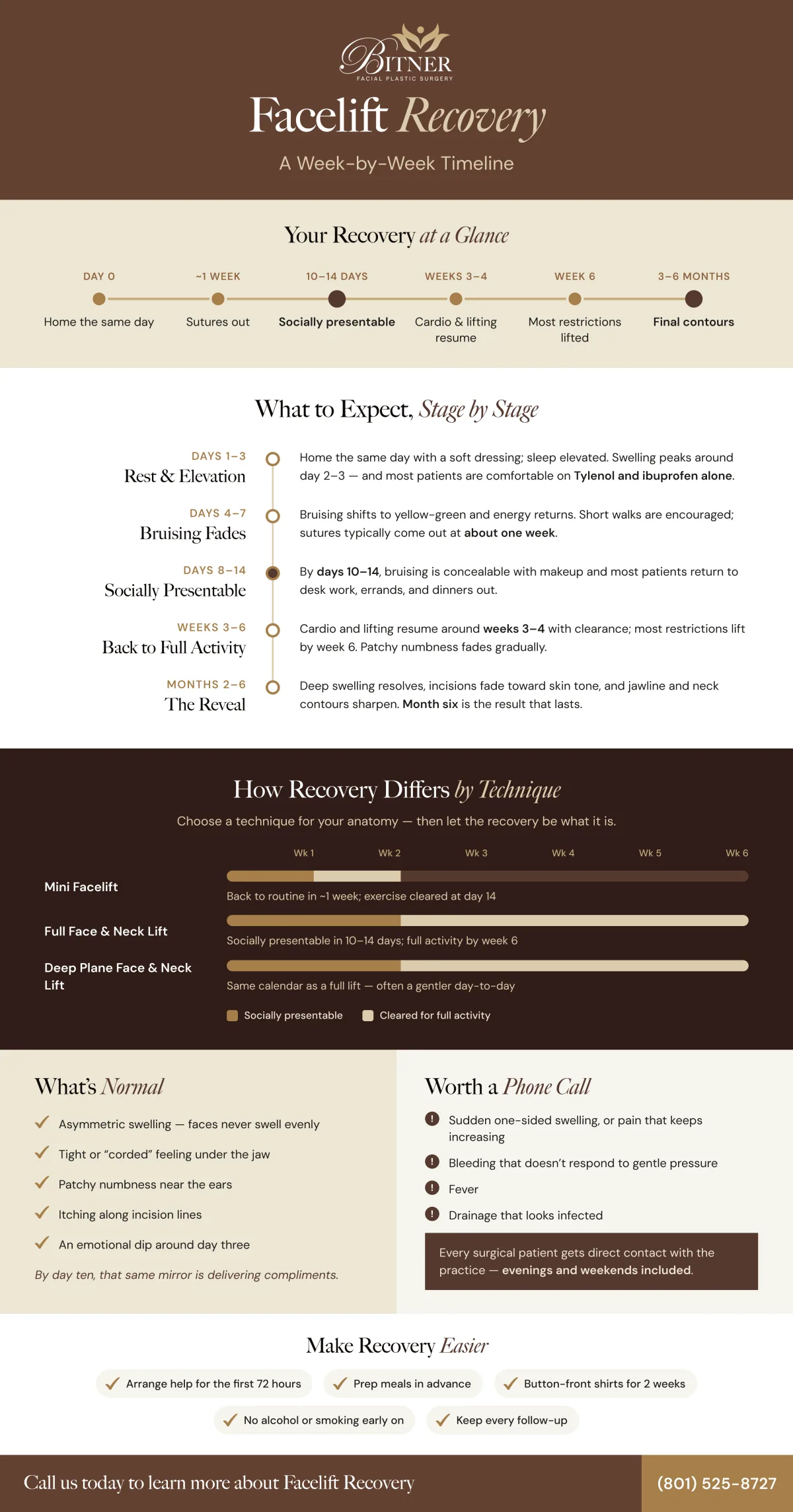
Most facelift patients are socially presentable within 10 to 14 days, back to full exercise by week four to six, and watching their final contours refine for several months after that. Recovery is rarely as difficult as patients expect — but the details depend on which facelift you’re having. This guide covers the general timeline every facelift surgery in Utah patient can expect, then breaks down how recovery differs between a mini, full, and deep plane lift. (Already planning a deep plane face and neck lift specifically? Our dedicated deep plane recovery guide walks that technique’s timeline in surgical detail — this article is the wider map.)
Days 1–3: Rest, Elevation, and Less Pain Than You Expect
The first three days are about protecting the surgical work. You’ll go home the same day with a soft dressing, sleep with your head elevated, and keep cool compresses nearby. Swelling and bruising peak around day two or three — this is normal and temporary.
What surprises most patients is how little pain there is. Because modern lifting techniques work beneath the skin rather than pulling on it, the dominant sensations are tightness and pressure, not sharp pain. Most of Dr. Bitner’s patients manage comfortably with Tylenol and ibuprofen alone. Sleep, hydrate, and let someone else handle the household for a few days.
Days 4–7: Bruising Fades, Energy Returns
By the end of the first week, swelling begins to recede and bruising shifts from purple to yellow-green as it fades. Most patients are up and moving around the house, taking short walks, and feeling more like themselves. Light activity is encouraged — gentle movement supports circulation and healing — but anything that raises your heart rate or blood pressure waits.
Sutures are typically removed at about one week. Many patients describe this visit as the turning point: the dressing routine simplifies, and the mirror starts showing progress instead of bruises.
Days 8–14: Socially Presentable
This is the window most patients plan around. Between days 10 and 14, residual bruising is usually concealable with makeup, swelling has settled enough that you look like yourself, and most people return to desk work, errands, and dinners out. Coworkers may notice you look rested; few will guess why.
Incision lines are still pink at this stage. They’re hidden in the natural creases around the ear and hairline, so they’re rarely visible in normal interaction — a topic we cover in detail in our companion piece on facelift scars and incision placement.
Weeks 3–6: Back to Full Activity
Cardio and lifting typically resume around weeks three to four with your surgeon’s clearance, and by week six most restrictions are lifted entirely. Numbness in patches of the cheeks or around the ears is common and resolves gradually — nerves are the slowest tissue to recover. Tightness continues to relax as swelling exits the deeper layers.
Tightness at this stage varies by technique more than any other symptom — which brings us to the question most patients actually have.
Months 2–6: The Reveal
The result you see at week two is good; the result at month three is better; the result at month six is the one that lasts. Residual deep swelling resolves slowly, incision lines fade from pink toward skin tone, and the jawline and neck contours sharpen as tissues settle into their new position. Photos taken at your follow-up visits usually tell the story better than the mirror does — the change is gradual enough that patients forget their starting point.
How Recovery Differs by Technique
The timeline above is the common skeleton; the technique you choose sets the pace. A mini facelift treats only the lower face through shorter incisions, so its recovery runs the fastest — most of Dr. Bitner’s Rapid-Recovery Mini-Lift patients are back to their routine in about a week, with exercise cleared at day 14. A full face and neck lift occupies the 10-to-14-day social recovery described above, with the six-week arc to full activity.
The deep plane facelift is the interesting case: although it’s the most comprehensive lift, many patients find its recovery more comfortable than older techniques, because the lift comes from repositioning deep structure rather than tensioning skin — there’s no pulled closure for healing skin to fight, and bruising from superficial dissection is reduced. Its calendar matches the full-lift timeline; its day-to-day experience is often gentler.
Two practical implications follow. First, don’t choose a technique for its recovery — choose it for your anatomy, and let the recovery be what it is; an under-treated face heals fast into a result you didn’t want. Second, read the guide that matches your plan: deep plane patients should follow the week-by-week deep plane guide linked above, while this article serves everyone still comparing options.
How to Make Your Recovery Easier
A few habits reliably improve the experience: arrange help for the first 72 hours, prep meals in advance, stock up on button-front shirts (nothing over the head for two weeks), skip alcohol and smoking entirely through early healing, and keep every follow-up appointment. Just as important: choose a practice that answers the phone. Recovery questions at 8 p.m. on day three deserve a real answer from the team that did your surgery.
Planning Your Facelift Around Your Calendar
Most patients budget two weeks away from public-facing obligations and six weeks away from the gym. If you have a wedding, reunion, or event on the calendar, count backward at least three months so you’re photographed at your best. Budget questions deserve homework too: the practice publishes current facelift cost information for every technique, including a detailed deep plane facelift cost guide. To find out which technique fits your anatomy — and what your personal recovery would look like — call (801) 525-8727 to schedule a consultation with Dr. Bitner in Layton, Utah. Your consultation fee is applied to the cost of your procedure.
What’s Normal — and What’s Worth a Phone Call
Almost everything on the standard recovery worry list is normal: asymmetric swelling (faces never swell evenly), tight or “corded” sensations under the jaw, patchy numbness near the ears, itching along incision lines, and emotional dips around day three when swelling peaks and sleep is disrupted. These are the ordinary physics of healing, and they resolve on schedule.
A short list genuinely warrants a call to the office: sudden one-sided swelling or pain that’s clearly increasing rather than plateauing, bleeding that doesn’t respond to gentle pressure, fever, or any drainage that looks infected. None are common; all are manageable when reported early — which is exactly why Dr. Bitner’s team gives every surgical patient direct instructions for reaching the practice, evenings and weekends included. The patients who recover most calmly are the ones who never wonder whether it’s “worth bothering the office.” It always is.
One more piece of normal that surprises people: the emotional arc. Day two or three often brings a “what did I do?” moment — bruised, puffy, and tired is nobody’s favorite reflection. By day ten, that same mirror is delivering compliments. Knowing the dip is coming is most of the cure for it.
Facelift Recovery FAQs
When can I exercise after a facelift?
Light walking is encouraged within days, but cardio, lifting, and anything that raises blood pressure waits until roughly weeks three to four, with full clearance typically by week six. Resuming too early prolongs swelling and can compromise healing, so Dr. Bitner clears each activity level at your follow-up visits.
When will I look normal after a facelift?
Most patients are socially presentable in 10 to 14 days, when bruising can be covered and swelling has settled enough to look like yourself. Contours keep refining for three to six months, so “normal” arrives in weeks — your best result arrives over the following months.
How long after a facelift can I drive?
Most patients drive again within five to seven days, once they’ve stopped prescription pain medication, can turn their head comfortably to check blind spots, and feel alert. If you needed only Tylenol and ibuprofen — as most of Dr. Bitner’s patients do — you may be ready sooner.
Sources: 1. Mayo Clinic — Face-lift: https://www.mayoclinic.org/tests-procedures/face-lift/about/pac-20394059 2. American Society of Plastic Surgeons — Facelift: https://www.plasticsurgery.org/cosmetic-procedures/facelift