

Most rhinoplasty patients return to work or school within 7–10 days, after the external splint is removed and bruising fades. Roughly 80–90% of swelling resolves by three months, exercise resumes in stages over four to six weeks, and the nasal tip continues refining for 12–18 months before results are final.
Medically reviewed by John Bitner, MD — Double Board-Certified Facial Plastic and Reconstructive Surgeon. Last updated: July 16, 2026.
The surgery itself takes a few hours. The recovery unfolds over months — and knowing what each stage looks like is the difference between healing with confidence and second-guessing every day in the mirror. This guide covers everything that happens after rhinoplasty, from the moment you wake up with a splint on your nose to the month your final tip definition emerges. If you are still preparing for surgery day itself, start with our pre-op companion guide, prepping for rhinoplasty surgery: everything you need to know — it covers medications to pause, supplies to gather, and how to set up your recovery space. Here, we focus entirely on what comes after.
How Long Does Rhinoplasty Recovery Take?
Most patients are back at work or school within 7–10 days of rhinoplasty, and most swelling — about 80–90% — resolves within three months. Complete healing, including the final refinement of the nasal tip, takes 12 to 18 months.
That long tail surprises many patients, so it helps to separate two very different timelines. The functional recovery is short: the splint comes off around day 7, bruising fades within two weeks, and you can resume nearly all normal activities within four to six weeks. The aesthetic recovery is long: swelling within the nasal skin and soft tissue resolves slowly, from the bridge downward, with the tip — where the skin is thickest — refining last. You will look normal to everyone else within two weeks. You will keep noticing improvements for more than a year.
Rhinoplasty Recovery: Week-by-Week Timeline
Here are the typical milestones. Your timeline may shift by a few days depending on the extent of your procedure, your skin thickness, and how closely you follow post-op instructions.
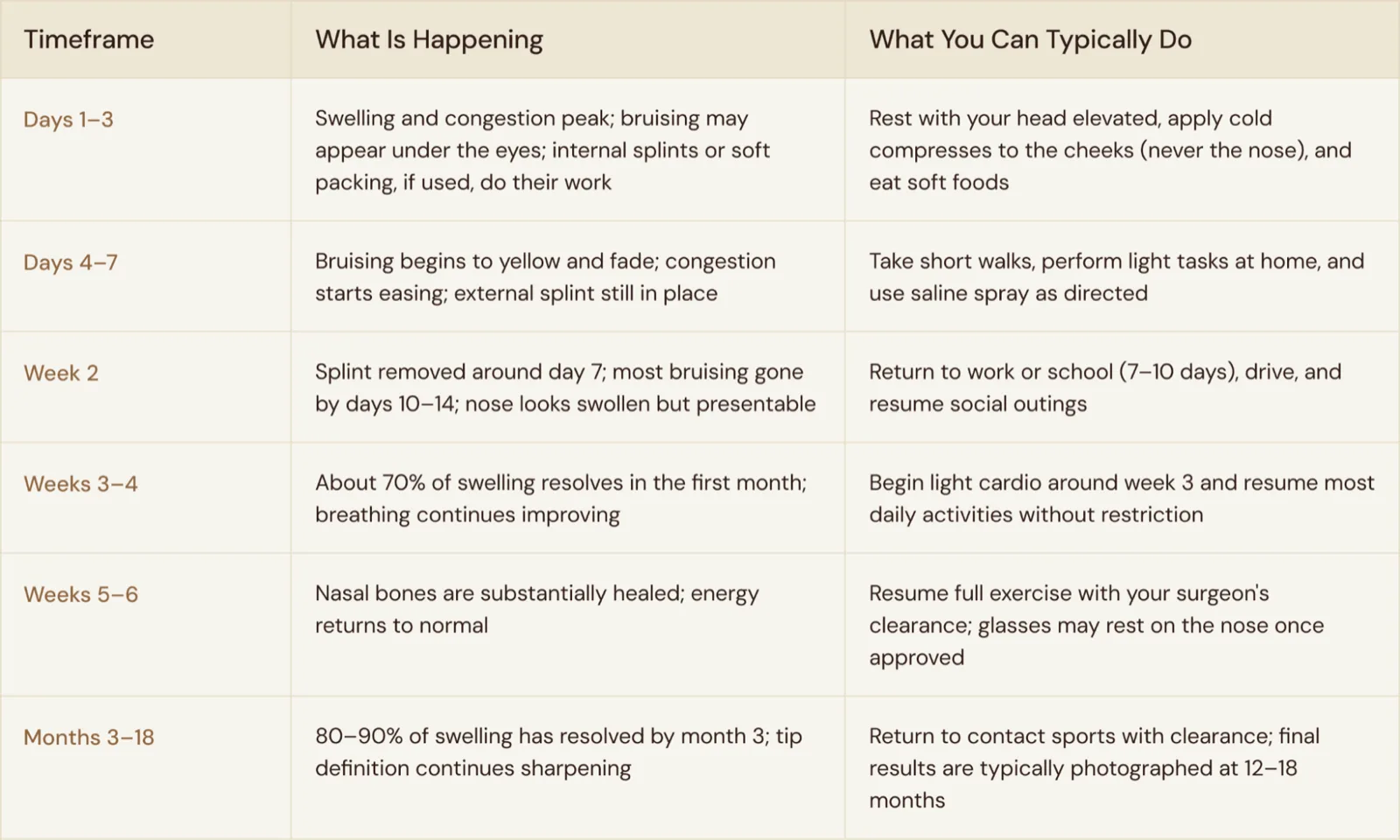
Days 1–7: The Splint Week
The first week is the only stretch most patients would call uncomfortable, and congestion — not pain — is usually the chief complaint. Swelling peaks around days 2–3 and then begins to recede.
Expect to breathe through your mouth for several days, since internal swelling narrows the nasal passages. Bruising beneath the lower eyelids is common when nasal bones are reshaped, and it follows a predictable arc: darkest at days 2–3, yellowing by day 5, largely gone by day 10–14. During this week:
- Sleep on your back with your head elevated on two to three pillows, or in a recliner.
- Apply cold compresses to the cheeks and under-eye area for the first 48 hours — never directly on the nose.
- Do not blow your nose; use saline spray to keep the passages moist.
- Avoid bending, lifting, and straining, which increase swelling and the risk of a nosebleed.
- Sneeze with your mouth open to protect the healing structures.
Around day 7, Dr. Bitner removes the external splint and any sutures that are not dissolvable. This is the emotional turning point of recovery: you see your new profile for the first time, swollen but recognizable.
Weeks 2–4: Back to Life, Still Healing Underneath
Most patients return to work, school, and social life between days 7 and 10 looking presentable — and the people around them rarely notice anything beyond mild puffiness. Roughly 70% of visible swelling resolves during the first month.
The nasal bones, however, are still knitting. Think of this period the way you would a healing fracture anywhere else in the body, because that is exactly what it is. Protect your nose accordingly:
- No glasses or sunglasses resting on the bridge for four to six weeks; tape them to your forehead or use cheek supports.
- No swimming, and keep the splint-line skin protected from sun with SPF 30 or higher.
- Resume light cardio — brisk walking, stationary cycling — around week three.
- Hold off on anything with a risk of facial contact.
Breathing typically improves week over week during this stage as internal swelling subsides, especially for patients whose procedure included septoplasty or turbinate reduction for airflow.
Months 2–6: The Swelling You Can No Longer See
By the end of month three, 80–90% of swelling has resolved, and to everyone but you and your surgeon, the result looks finished. Full-contact activities generally resume around six weeks to three months with clearance, once the nasal bones have regained their strength.
What remains after month three is subtle soft-tissue swelling concentrated in the tip and supratip — the area just above the tip. It comes and goes: many patients notice their nose looks slightly fuller in the morning or after salty meals, then refines as the day goes on. This is normal lymphatic behavior in healing tissue, not a problem with the result.
Months 6–18: Final Tip Definition
The last stage of rhinoplasty recovery is the slow sharpening of tip definition, complete by 12–18 months. Patients with thicker, more sebaceous skin, and those undergoing revision rhinoplasty, tend to finish at the later end of that range.
This is why reputable surgeons photograph final results at a year or beyond, and why judging your outcome at month two sells the result short. The underlying cartilage framework — the reshaped lower lateral cartilages, any grafts placed for support — was set on the day of surgery. What changes over these months is simply the skin envelope shrinking down to reveal it. You can see representative healed outcomes in our photo gallery to calibrate expectations for your own timeline. Patients often return for follow-up procedures or refer loved ones because of the trust they’ve built.
What Speeds Up — and Slows Down — Rhinoplasty Healing
You control more of your recovery timeline than you might think. Consistent habits in the first six weeks measurably reduce swelling duration.
Helpful: strict head elevation for two weeks, low-sodium diet, hydration, saline spray, patience with the process, and attending every follow-up visit. Harmful: nicotine in any form, alcohol in the first two weeks, NSAIDs before they are cleared, early strenuous exercise, and glasses on the bridge before approval. None of these shortcuts are worth risking the precision achieved in the operating room.
Frequently Asked Questions
How long does rhinoplasty recovery take?
Most rhinoplasty patients return to work or school within 7–10 days, once the splint is removed and bruising fades. Roughly 80–90% of swelling resolves by three months, while the nasal tip refines gradually over 12–18 months before results are considered final.
When can I wear glasses after rhinoplasty?
Most patients should keep glasses off the nasal bridge for four to six weeks after rhinoplasty. Resting frames on healing nasal bones can shift them or leave an indentation. Until Dr. Bitner clears you, tape glasses to your forehead, use cheek rests, or switch to contact lenses.
How long does swelling last after rhinoplasty?
Most rhinoplasty swelling resolves within two to three months, but subtle tip swelling can persist for 12–18 months. About 70% of swelling fades in the first month and 80–90% by month three. Thicker skin, revision surgery, and extensive tip work all lengthen the timeline.
Schedule a Consultation
Rhinoplasty rewards planning — and the right plan starts with an examination of your nasal anatomy, your breathing, and your goals. Dr. Bitner has devoted his practice exclusively to the face for more than 16 years and will map out both your procedure and your personal recovery timeline. Call (801) 525-8727 to schedule a consultation today — the $250 consultation fee is applied to the cost of your procedure.
Dr. Bitner Facial Plastic Surgery, 425 S 100 W, Layton, UT 84041