

Most facelifts last 8–12 years, and the deep plane facelift sits at the upper end of that range. Because the technique releases and repositions the deeper SMAS layer and its retaining ligaments — rather than pulling skin tight — results settle naturally and hold up longer as the face continues to age.
Medically reviewed by John Bitner, MD — Double Board-Certified Facial Plastic and Reconstructive Surgeon. Last updated: July 7, 2026.
If you are weighing the time, recovery, and expense of facial surgery, longevity is a fair place to start. A facelift is not a permanent pause button, but the technique your surgeon uses has a measurable effect on how long the improvement holds. At Dr. Bitner Facial Plastic Surgery, the deep plane face and neck lift is the technique Dr. Bitner most often recommends for patients in their 40s through 70s — in large part because of how it ages. Rather than stretching skin over descending tissue, it repositions the structural layer of the face itself. This article explains what the 8–12 year figure really means, why the deep plane approach sits at the upper end of it, and what you can do to protect your result.
What “Lasting” Really Means After a Facelift
A facelift lasts in the sense that it turns back the clock, not in the sense that it stops it. When surgeons say most facelifts last 8–12 years, they mean that is roughly how long it takes gradual, ongoing aging to soften the visible improvement — not that your face reverts on a set date.
Aging continues after any facelift. Skin slowly loses collagen and elastin, facial fat compartments deflate and descend, and the underlying bone remodels over decades. What a well-performed lift changes is your starting point. A patient who has surgery at 52 and ages naturally afterward will consistently look younger at 62 than she would have without the procedure. In other words, the comparison that matters is not “before surgery vs. ten years later.” It is “ten years later with surgery vs. ten years later without it.” By that measure, the benefit never fully disappears — it simply becomes less dramatic as the years accumulate.
Why the Deep Plane Technique Sits at the Upper End of the 8–12 Year Range
The deep plane facelift lasts toward the upper end of the 8–12 year range because it releases and repositions the SMAS — the superficial musculoaponeurotic system — along with the ligaments that anchor it, instead of relying on skin tension. Skin is elastic by design; it stretches back. The deeper fibrous layer holds its new position far more reliably.
During a deep plane procedure, Dr. Bitner elevates the skin and SMAS together as one composite flap, then releases the key retaining ligaments — including the zygomatic cutaneous ligaments near the cheekbone and the masseteric cutaneous ligaments along the jaw — that tether sagging tissue in place. Once released, the midface, jowls, and platysma muscle of the neck can be repositioned as a unit and secured where they sat years earlier. The skin is then redraped and closed without tension.
Compare that with older or more limited approaches. A skin-only lift places all of the tension on the most elastic tissue in the face, which is why those results relax noticeably sooner. A SMAS plication lift folds and sutures the deeper layer without fully releasing the ligaments, producing solid but generally shorter-lived improvement. For a detailed comparison of the two leading techniques, see our guide to the difference between a deep plane and SMAS facelift.
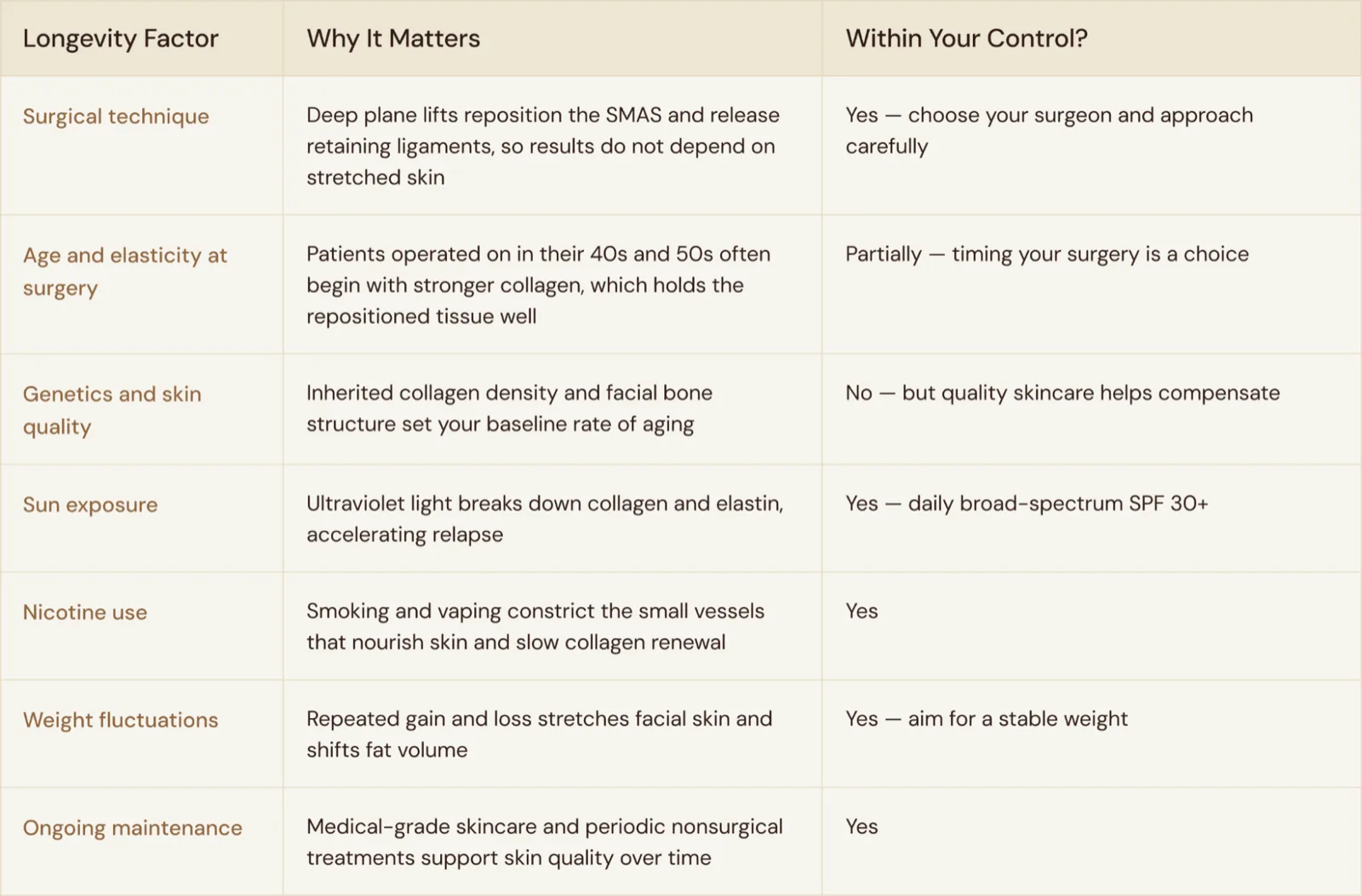
The Factors That Influence How Long Your Results Last
Technique matters most, but it is not the only variable. Your anatomy, habits, and aftercare all influence where within — or beyond — the typical range your result will land.
A Realistic Timeline of Your Result Over the Years
Expect your result to evolve in phases rather than change abruptly. Here is the arc most deep plane patients experience:
- Months 1–3: Swelling resolves and tissues settle; contours along the jawline and neck sharpen week by week.
- Month 6 to year 1: Your result reaches its refined, “final” appearance. Incision lines continue fading through the first 12 months.
- Years 2–7: The stable plateau. Most patients see little visible change beyond ordinary skin aging.
- Years 8–12: Gradual relaxation becomes noticeable, particularly in the neck and jowl area — though patients still look years younger than they would have without surgery.
How to Protect and Extend Your Facelift Result
Daily habits can push your result toward the upper end of the range. None of these are complicated, but consistency matters more than intensity:
- Wear broad-spectrum SPF 30 or higher every day, and reapply during outdoor activity.
- Use a retinoid and antioxidant serum as part of a medical-grade skincare routine.
- Avoid nicotine in every form — before surgery, during recovery, and afterward.
- Keep your weight stable to prevent stretching and deflation cycles.
- Consider periodic maintenance treatments, such as skin resurfacing, as recommended at your follow-up visits.
When a Second Procedure Makes Sense
Some patients eventually choose a second, smaller procedure a decade or more after their first — and many never feel the need. Because the foundation was repositioned the first time, later touch-ups are typically less extensive than the original operation. Patients often return for follow-up procedures or refer loved ones because of the trust they’ve built. If you are weighing long-term value, our overview of the cost of facial plastic surgery explains what goes into surgical fees and how consultations work.
Frequently Asked Questions
How long does a deep plane facelift last?
Most facelifts last 8–12 years, with the deep plane technique at the upper end of that range. Because it repositions the SMAS layer and releases its retaining ligaments instead of tensioning skin, the lifted foundation ages more gracefully. Your skin quality, sun habits, and genetics also influence how long results remain visible.
Does a deep plane facelift last longer than a mini facelift?
Yes, a deep plane facelift generally lasts longer than a mini facelift. A mini facelift addresses early jowling through smaller incisions and more limited tissue repositioning, so improvement is subtler and shorter-lived. The deep plane approach lifts the face at the structural level, which keeps results at the upper end of the 8–12 year range.
Can you have a second facelift after a deep plane facelift?
Yes, a second facelift can be performed safely once earlier results have relaxed, often 10 or more years later. Many patients never need one; others choose a smaller refresh procedure instead. During a consultation, Dr. Bitner evaluates your tissue quality and goals before recommending whether a repeat lift makes sense.
Schedule a Consultation
If you are considering a deep plane facelift and want a candid assessment of what it can do for you — and how long you can expect it to last — Dr. Bitner will examine your facial anatomy, discuss your goals, and recommend the approach that fits. With 16+ years of experience and a practice devoted exclusively to the face, he can help you make a confident, informed decision. Call (801) 525-8727 to schedule a consultation today — the $250 consultation fee is applied to the cost of your procedure.
Dr. Bitner Facial Plastic Surgery, 425 S 100 W, Layton, UT 84041